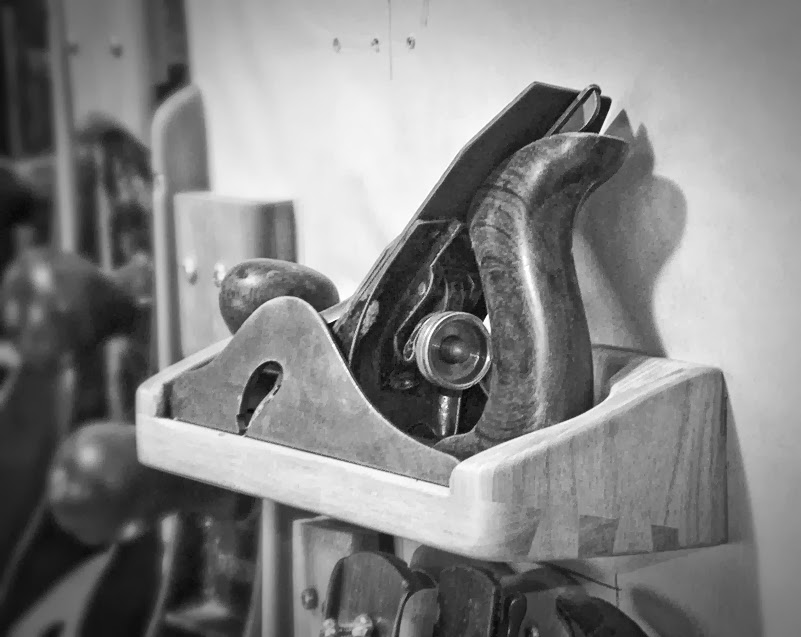
Tuesday, 21 January 2014

I'm Sure I Did This Once...

This is my first time working with recycled wood. There is a tree-hugger out there somewhere that owes me lunch.


This oak originally made up my wife's plant stand, that big monstrosity I made and wrote about a few years ago. It is a long story why this plant stand came to be garbage in a few short years, but to explain it, I'll try to incorporate some brevity, although that certainly isn't my long-suit.

I started making this stand not long after my in-laws had moved in with us. At the time, my wife and her mother had agreed to disagree about everything that encompassed co-existing together in the same domicile. I loved my mother-in-law dearly before she move in with us, and I love her to death now, but the reality is, the poor ol' girl had a childhood, if that is what it could be called, that was more horrific than anything I could ever imagine. Through no fault of her own, what she endured back then had warped her perspective on life, as well as all those within it. As she aged, those issues became magnified and although she barely stands 4' 8", she became a force that is beyond being reckoned with. As a result, my poor wife went through royal hell and back trying to cope with her.

While I always knew my mother-in-law had issues, I agreed to have them move in with us because, having watched her with my wife for over 30-years, I felt the last thing she would ever do was endanger the relationship she had with her daughter. We all make mistakes, I guess. Within a few short months of them moving in I had realized that the situation was unliveable, having come to this conclusion long before my wife was forced to finally admit it to herself, as well as me. At the time I had to think long and hard about what to do about it, and in the end, I chose to do nothing but live within it. That may sound strange, but I came to this conclusion after remembering something I had read a long time ago. It was either an old proverb written on the inside of a pyramid wall, or graffiti, written up high on a bathroom wall, I'm not sure which, but it said; "Lo I say unto you, suffer the man who darest to come between his wife and his mother-in-law, for he shall soon become dead meat", or something similar. OK, this proverb/graffiti story is bullshit, but the message is true. I knew that I had let my wife have her lead and try to ensure that her actions towards her parents were of her own choosing, all made with a rational mind free from anger. If I chose to dissolve the arrangement, guilt would cause her to resent me for it later, and if I let her make rash decisions about it, guilt would cause her to resent herself. I figured that my wife and I would be together long after her parents were gone, so, for me, not doing anything was an investment in that future. As things turned out, all I did for the more than three years we had them with us was to keep my mouth shut and stalled every time she insisted we were throwing them out. It was a long, long three years.

Yes, I remember...brevity...

I didn't build the plant stand because I felt horrible for not being able to "fix it" or to have an excuse to hide. The only reason for creating it was in hope it might give my wife something to escape to. I put it together unfinished, doing so in a way that allowed any or all the pieces to be removed for finishing, giving her a workable product as quickly as possible. I also gave her a crate full of young orchids at the time, so not only did she have somewhere to work, but something to work on. I chose orchids because I had read they were a bitch to grow. The whole thing didn't work as well as I had hoped, but it worked well enough for her to find some diversion with it.

In the end, the health and mental faculties of the two old souls deteriorated to the point where full-time, professional help was needed. My wife and I moved out and left her parents in our condo, letting them live there until they no longer needed it, while we moved into our current home, which has a huge bay window that is just perfect for growing orchids. This made the stand unnecessary, so I tried it for displaying tools on in my office, but because the shelves were few and far between - literally, I chose to disassemble it and keep the wood for another project.

Just to finish the story, in case you might be interested, my wife's parents moved out of the condo a few months ago, taking up residence in a full-care retirement home. As I write this, my mother-in-law, bless her heart, is in the hospital suffering with a blood clot which the doctors are having a devil of a time locating so they can remove it. My wife is very slowly getting her wits back again and is currently staying at the retirement home with her father, ensuring that his dementia doesn't overtake his emotions caused by his wife not being around. And me, I'm relieved everything turned out for the best and I am currently removing the stained, varnished and steelwool-rubbed waxed finish off of the hacked up boards that once made up that plant stand so I can use them to build a portable vise. Sad, really.

Sad, and a bitch of an amount of work. I've stripped wood before, but only with chemicals. This time I chose to scrap the finish down to bare wood with a paint scrapper, resulting in all the surfaces needing to be re-trued. I didn't start out this way. I first sharpened a trashed blade for this purpose, but found the finish was so thick and slippery, the blade just skated across the board, removing zero to very little in the process. I had no choice but to go the scrapper route, discovering that it took an hour to do both sides of one 26-inch board. Given the stack you see in the background of the photo, I figure I'll be preparing stock for the next month and not much else, hence my opening statement about the tree-hugger that owes me lunch.

Peace,

Mitchell

Saturday, 18 January 2014

What Really Defines a Canadian...


I'm not sure which defines me more as a Canadian; the fact that I had to shovel snow and chip ice off my deck and outdoor workbench so I could rip all this recycled oak down to width, or that I have been bitching about how I froze my butt off doing it to anyone who will listen ever since?

Peace,

Mitchell

Wednesday, 15 January 2014

I Just Have To Mess With It...

If the projects I currently have on my plate were actual food, I'd be a bloody glutton. Here is what I am milling wood for today...


This is a remake of the plans for a portable vise that I have been mucking with for the past few months. As you can see, I never know when to leave things the hell alone.

First, thanks to Anonymous, whoever and which one he is, it is now being made of red oak, recycled red oak to be exact. As it turns out, it is surprisingly light for its strength and ability to take a beating.

Second, the vise bed hasn't changed much except it is now going to be constructed out of ¾" stock because that is what I have a ton of in my little material stash.

Third, I am adding a shoot board to one side of it. Only time will tell if this is brilliant or idiotic, but I came up with this because of a revelation I had the other night - I'm getting seriously lazy in my old age. I expect to use this vise as much as I do my makeshift shooting board, so if I make two separate units, I would have twice as much to carry. 

Forth, because I have learned the hard way that shooting boards require some sort of adjustment ability on their fences because, for a multiple number of reasons, they get out of whack occasionally, I'm adding one here. The three items at the bottom-left of the line-drawing show three views of the adjustable fence. It is a pretty simple design, actually. This mental-midget brainwave has six parts. 
  • Two brass pins that match the dog-holes in the vise, made out of brass because a leap of faith told me they might last longer than wood pins, but also because I can drill down their length and tap them.
  • Two bolts; one that will act as a pivot for the adjustments and another to hold the adjustment for, hopefully, longer than one or two plane runs.
  • One 1¾" x 1¾" strip of oak that has the brass pins attached to it so it acts as the anchor for the fence.
  • One 3" x 2½" strip of oak that has a wedge shaped cut-out that fits over the lower strip of oak, giving a ½" of adjustment at one end while being fixed in place at the pivot end.
The only other thing I can add to it is the vise will have 2-across dog holes from the head of the vise to just beyond where the screw and stabilizers end. From that point to the end of the vise there will be 4 dog holes across the width of the bed. While these holes may be used to secure stock, they are really there for the fence, allowing me to move it quite a bit forward so the plane has travelling space after the stock and I won't have to reach as far while using it. It also allows me to move the pins that hold the fence outboard so they can better take the beating I am expecting to give them. Also, the bed that the shoot plane will travel along is ramped downwards 1¼". Research has told me that there isn't any advantage to a ramped shoot board but I am going to ramp this one simply because I think it will allow the blade wear to be spread over a wider area, increasing its use between blade sharpenings.

Lastly, the plans do not show any bench hooks but that is because I haven't quite finalized how I'm going to add movable hooks. If I can move them, I can set the thing up to work from either side or end of the bench.

Only time will tell if this is brilliance or bullshit, so we will have to see. I'm heading to the outside bench today to freeze my butt off while ripping a bunch of 5" wide oak down to 4". Hopefully this project won't take as long as those damned blade retainers I am also currently making for a frame saw. I thought I could bang them off quite quickly, but it isn't quite the job I thought it would be. So far I have the threads cut on the blade tightener, but that is about it. Because my lathe isn't set up yet, I had to hand-file ⁵⁄₈" square brass stock down to ½" round...


Peace,

Mitchell

Monday, 6 January 2014

Up, Up and Away...I Hope...


Am I imagining things, or are the prices of planes going up?

I have been pondering this possibility for a while now. I think the online dealers' prices have been slowly creeping up over the past couple of months and while the typical eBay junk is still the same,  the eBay dealers' prices are also climbing a bit. I thought maybe it was my imagination, but after having a gander at Leach's preverbal tool list this morning, I'm starting to waver between possible and probable.

Here's a few examples that have caused me to firm up my opinion a bit...
ST12 #2 smoothing plane; a cleaned ca. 1900 example, with a 1930's iron, a no-harm bruise at toe, lever cap is a #3 ground narrower to fit the plane, it's a solid worker in all regards, and priced for someone who doesn't wish to pay the MSRP of a pristine example; top right: http://www.supertool.com/forsale/jan/t17.jpg - $175.00
I also came across one of these on eBay this morning that was a tad rough around the edges, but over-all not a bad type 7 that an eBay dealer was selling for $295.00.

I have two of these, both bought from dealers and both graded on the cusp of excellent-workers and good-collectors. One I paid $45.00 for and the other, $125.00, both within the last 5 years.
ST68 #7 jointer; a type 11, with all original parts, made ca. WWI, no damage, nicely cleaned, 90% japanning, all it needs is honing; bottom: http://www.supertool.com/forsale/jan/t128.jpg - $185.00
I bought a type 7 three years ago from a dealer for $175 and its condition is so good, I thought it was still under warranty.

As an aside, Patrick had one listing that really firmed up my decision to never buy a No.1...
ST51 #1 smoothing plane, damage, offered for parts; the nose section snapped off, it has a good "STANLEY" embossed lever cap, sweetheart logo iron and cap iron, and frog; top of tote is gone; the front section can be ground clean to make it a chisel plane, or you can grab parts off it for your plane; top left: http://www.supertool.com/forsale/jan/t107.jpg - $345.00
A couple of years ago another dealer had a box for a No.1 listed for $1400.00 - just the box. Now Patrick has the back half of one listed for $345.00. I get the rarity of this plane is what drives the price, but still...sheesh. The only reason it is rare is that no woodworker worth his salt wanted one of these silly little things when they were new.

By the way, if you aren't getting them already, you can sign up to receive Patrick's SuperTool monthly lists by emailing him at leach@supertool.com.

So is it possible that plane prices are creeping up? I'm still not sure because that isn't supposed to happen. There has been an unbelievable number of vintage planes that have been dumped on the market over the past few years, mainly coming from collectors who are liquidating, or from their heirs who want nothing to do with a bunch of old tools. When supply outstrips demand, prices fall, so how can inflationary prices exist in the market? If it is happening...cool.

This probably isn't the time to mention this, but I am still looking for a good type 7 No. 6 Stanley, and if anyone knows a screw from another plane that will work to holding a Stanley No.386 fence to a plane, I would appreciate you letting me know. Finding replacement thumb screws for this fence is a real bugger.

I had to stop working on the mount for my Stanley No. 50 because I want to tie it into the mount for my No.51 that is going to run up beside it. Here is where it stands today with the template for a layout for its mates...


It really was a difficult plane to design a mount for, which ended up with more dips and dives than I expected. The entire thing is made from a glue-up of walnut with all the grains running vertical.

Here is the plane head-on. With all its bits and bobs, it is 3" wide, but because the widest part of the actual plane body is the tote that is slightly thicker than ¾", there is a lot of empty space around it, making the mount look like a 1950's era continental kit...


Because I have a lot of resawing to do for this project, I decided it was time to make the Frame-Saw I bought blades for about 4-years ago, so that will be what I will be posting about next. Because I do not have my lathe up and running, I'm currently rounding off parts of some ⁵⁄₈" square brass stock by hand so I can thread them. I should have photos and my usual verbal diarrhea about them up within the week.

Peace,

Mitchell

Thursday, 26 December 2013

Keep Your Two Front Teeth and Give Me...

It is Christmas…well…actually, it is Boxing Day, but close enough. Let me wish all of you the very, very best for the holiday season and may the coming year bring with it health and happiness for you and your families.

While I have spent a great deal of time over the past few days thinking about Christmas’ past, I have also spent some time thinking about what would be my ultimate Christmas present. While I came up with a number of them, I thought I would share a couple of them with you.

Here are three requests from my 2014 Christmas gift list for Santa:
  • Santa, please make some sense out of the cost of raw materials.
    • There was a time when I would build something just because the store-bought variety of what I wanted was just too damned expensive. Today, it is often cheaper to buy the finished product than it is the raw materials to build it. Why is it that the local box-store can sell a complete knockdown shelving unit for $39.95, while that same store sells the sheet of plywood I would need to build it myself for $47.00? WTF?
  • Santa, please equalize attempts to bring down selling prices.
    • I remember when a power tool was expensive. Today, you can buy a table saw for as little as $110.00, a power drill for slightly more than 20-bucks and a skill saw for $60.00. It used to be that power hand tools cost more than a week’s wages, yet today, we can buy them for less than 10% of our net paycheque. Back in 1968, I was making $2.24 an hour as an apprentice body man, which was a good salary back then. I worked part-time in my parents’ corner store and remember that we sold a quart of milk for 39¢, or roughly 17.5% of my hourly wage. Today, a quart of milk cost $3.29 (actually it is a liter, so it is slightly smaller) and the average hourly wage in Ontario is $15.00, so a quart of milk costs roughly 22% of the average persons hourly wage. It seems that the only corporations that focus on the volume/profit ratio are the ones producing discretionary items. WTF?
  • Santa, please get rid of box-stores.
    • Years ago, when I was living in London, Ontario, Canada, my old man would have a building project and our first stop was always at Copps Lumber. Copps was the box-store of yesteryear. They sold everything from tools to trim, all under one roof. We would walk up to the sales counter and go through the list with someone who was a trained carpenter by trade. He would check our calculations, suggest product options, and in the end, produce two copies of the bill; one for us and the other for the yardman. The old man would then back his station-wagon up to the loading dock, hand the next yardman who became available his copy of the bill, and within a short period of time, oversee the loading of the materials into the car. Today, we have the box-stores, places where you can wander around for hours just trying to find what you want, load it onto the gurneys yourself, haul it to the checkout line, wait to be checked out and then load it all yourself into your car that is usually parked as far away from the door as possible. This is progress? There are a few old lumberyards still around, the one I frequent in Toronto being Central Fairbanks Lumber. Ironically, they are located directly across the road from a Home Depot location. While their salesperson/customer ratio is slightly lower than what I remember of Copps, it can’t be compared to the ratio that exists across the road at Home Depot, which, I think, really doesn’t have one. The main difference, though, is in the order processing. I have spent a half-day putting an order together at Home Depot, which I later discovered could be done in less than an hour at Fairbanks. Given that Fairbanks sells that box-store $47.00 sheet of plywood I previously mentioned for $48.50, there is a cost for better service, but with large orders, there is a savings even when the higher material costs are added in. If you think about it, box-stores make you spend a great deal of time to do all their work and pay you less than minimum wage for doing it. WTF?

So there you go – some of what I want for Christmas 2014.

Peace,

Mitchell


Wednesday, 18 December 2013


When I started this remake of my tool cabinet I decided to keep it simple, letting the tools speak for themselves, so-to-speak. I thought the best way to do this was to keep the extras limited to simple curves, but theory and practise don't always jive.

The mount I'm working on is for the Stanley No. 50, a little bodied plane that has a great deal of projections that make it end up being pretty cumbersome. When you add in all its bits and bobs, you come up with a mount that is pretty massive. The end result reminded me of those old continental kits the more-is-better crowd used to bolt to the ass-end of their cars back in the 50's. Somehow I had to get some balance in it.

To do this, I decided to tie in a couple of other plane mounts, thinking that adding more wood below it would trick the eye into seeing its height, rather than its depth. It actually worked, but it added another problem in the process. The additional height resulted in a fairly large expanse of wood, nice wood mind you, but still a lot of wood. It needed something to break up the expanse, but retain the height it needed. I needed to add a little interest to the wood.

To accomplish this, I decided to add curves - lots of them...


I have to admit, this is the first time I have tried my hand at traditional carving. Given this was my first time out of the barn, I think I did all right with it.

I still have a bunch of work to do on this mount, so I'll leave the rest of it until later.

Peace,

Mitchell


Wednesday, 4 December 2013

Update On My Portable Vise Design...

A few weeks ago I posted an article about a portable vise I had designed. Before it was posted I had already placed an order with a local wood supplier for enough Beech to build it, but hit a snag a few days afterwards. The yard had problems coming up with Beech in the thickness I wanted, which was 1½". I called around to a few other local suppliers and heard the same story; nothing thicker than 1". I found that I could get the stock I needed from a supplier in the States, but was shocked at the cost to ship it up to me. When I stated such, the supplier said something that made me rethink my choice of Beech for this project, which was; "Beech isn't exactly the lightest species of wood." Given this is supposed to be a "portable" vise, naturally this comment caught my attention. I ain't gettin' any younger here, so not wanting to have to slug around something that weighed a ton, I thought I should do some more research.

Almost everything about workbenches that I came across stated that Beech was the material of choice, mainly due to its "density". Why everything to do with woodworking has to be so bloody technical, I'll never know, but I decided to see if there were other species of wood that came close to Beech's "density", but weighed less. I had seen Density Values listed on many different wood suppliers' websites but I really didn't have a clue what it really meant, so I decided the first up on my agenda should be figuring out exactly what the hell "density" meant.

Huge mistake.

I really have to be honest here; I am so far removed from an analytical thought process, I don't even fully understand what that term really means, so trying to decipher pretty much all of the definitions for "Density" that I found was as impossible for me as making cream from sand. Why do those that post definitions on the web think everyone is as like-minded as they are? Hell, if I could think like them I wouldn't be reading their damned definitions in the first place, but instead, I would be posting my own, which, I must admit, is exactly what I am going to try to do here, but one I came up with that, hopefully, rewrites the gobbledygook in laymen's terms.

den·si·ty (dÄ•n'sÄ­-tÄ“)

  1. Basically, the amount of wood in a piece of wood.
  2. The more "fibers" (read that as "wood") a wood has per square-whatever, the stronger it is.
  3. Density of wood is defined by a decimal value.
  4. The more dense the wood, the higher the decimal value.
  5. The higher the density value, the stronger the wood is, which means the less effect wailing on it has.
  6. There are as many different ways to calculate a wood's density as there are species of the damned stuff, which causes me to believe that anyone in their right mind should stay the hell away from the subject whenever possible. (which, in turn, explains why I didn't)
  7. The standard way to measure the density of wood, or at least the way I gleaned it to be from reading about 100 different articles on the subject, is by taking the weight of a specific volume of wood which has been properly dried and dividing it by the weight of the same measurement of the same species of wood which hasn't, or is still "green".
  8. Once you understand the principles of calculating Density Values, you realize that to calculate it, you first have to find the weight of the particular species of wood you want to know about in both its green and dry configurations, and if you can do that, you can also find a Density Value list somewhere, so for God's sake, use it, and forget about going through all this other shit!

So putting all rational thought aside, I took my new-found knowledge for a test drive and learned...

  • A cubic foot of dried Beech has a weight of 45-pounds and by dividing that value by the weight of a cubic foot of green Beech, which is 54-pounds, the density factor of dried Beech is 0.8333, or at least that is the value I am going to apply to it, despite any critics.
  • Comparing that value with one for Poplar, for which a cubic foot of dried has a weight of 28-pounds and a cubic foot of green is stated to be 39-pounds, means that Poplar has a density value of 0.737, much less than Beech.
  • With those two values as a base for "good" and "bad" densities for workbench production, I checked out Black Maple, which is one of the harder species and one that weighs in at 40-pounds dried and 54-pounds green; giving it has a density value of 0.740, meaning it isn't much better as a material to build a workbench from than Poplar, which was a bit of a surprise.
  • Checking out the Mahogany that I have had hanging around in my stash for over 10-years now and the material was thinking of using for this portable vise, I found it has a density value of 0.735, which tells me, as a workbench, it would really suck.
  • So I did the same for the Red Oak that I also have in my stash, and found that its density value of 0.688, which means it will suck even more than the mahogany.

One of the main things I learned through this exercise was that I wasn't as smart an ass as I thought I was, so I'm going to have to head back to the drawing board and come up with a better design for this portable bench that is lighter, but just as strong. I also learned that it will have to be made from...go figure...Beech, and more specifically, Beech in 1" thicknesses.

Peace,

Mitchell


Tuesday, 26 November 2013

This Is The End Grain Of All End Grains...

Red and White oak cabinetry by Hawkeye Carpentry.
I received an email from Longleaf Lumber today which I thought was pretty interesting. Longleaf is an antique and reclaimed lumber company who have operations in Cambridge, Massachusetts, New York City, New York, and Berwick, Maine. They collect their wares from all over the United States and if you visit their site, check out the "History and News" page. Some of the buildings listed that they have reclaimed lumber from recently are a major part of American history and it is nice to see these aged resources are not going to waste. Like all lumber yards, they carry pine, oak, chestnut and even some hemlock, but the difference between Longleaf and the usual mill is that Longleaf's lumber is all 100-years old or more. As we all know, nothing ages better than wood.


To promote themselves and increase the interest in reclaimed and salvaged wood, Longleaf has started a monthly competition called, "This Is The End Grain". Every month they will grab an interesting hunk of lumber from their stock, shoot a photo of its end grain and post it on their Facebook page. Everyone is invited to check it out and take a guess as to what type of species it is. The winner for the month is either the one person with the correct guess, or a randomly selected winner from a group of correct guesses. Each monthly winner will win something they call "reclaimed, wood and gorgeous". I would hazard a guess here and say that they mean the prize will be a good hunk of reclaimed lumber. That works for me, although I have trouble recognizing the difference between newly milled maple and ash, so I think my chances will be slim to none, but I'll give it a shot just for kicks.

If you want to check out December's photo, check out their Facebook page and give it a go, just bare in mind that you will be looking at the end grain of a really, really old piece of lumber. Calculating its species is gonna' be tricky. While you are there, if you think they are worthy, give them the ol' "Like".

Peace,

Mitchell

P.S.: I have never made a single purchase from Longleaf Lumber so I have no idea regarding their service or prices. There are three reasons why I am posting this article; 1) I think it would be cool to win a hunk of 100-year-old-plus wood so I wanted everyone to share in the chance to do so, 2) I support those who deal in reclaimed wood because I am a bit of an environmental junkie, and 3) from the few pieces of reclaimed lumber that I have worked with as well as others that I have seen, reclaimed rules simply because it is bloody gorgeous. I have not been offered anything for posting this, I haven't asked for anything for posting this and I wouldn't take anything for posting this if it was offered to me.


Saturday, 23 November 2013

Doodling On Wood...

I just finished another plane mount for the cabinet and I am pretty pleased with the results. Once I got it done I started to think about why I enjoy making things like this without drawing up plans for it first. In the end, I came to what I think is a pretty humorous conclusion.

As a kid, I was obsessed with doodling in the margins of every piece of paper put in front of me. My little doodles ranged from simple line drawings of patterns, to complex full-out sketches. While I could say that my mainstay was doodling cars, in truth, anything that popped into my imagination ended up somewhere in the margins of whatever paper showed up in front of me. I remember sitting through a biz class at university, years ago, where the prof was giving a lecture using an oil refinery as a business model. While he was droning on about production factors, arbitrages and variables, I was busy doodling a couple of 40-gallon oil drums mounted in a rack which I drew as being stored up against the wall of an old gas station. I wish I still had that sketch as it was pretty elaborate, with empty oil cans and rusted bits of car parts stacked all around the oil drums. It was probably one of the most enjoyable two-hour lectures that I ever sat through with that prof and probably also answers the question of why I ended up in the graphic arts business as well, but that is another topic.

Anyway, taking this trip down memory lane made me realize that my penchant for doing little woodworking projects without the benefit of plans is just an extension of the doodling I did before my computers made notepaper obsolete  As a kid I doodled on paper. As an old fart, I'm now doodling on wood.

Here is my latest doodle...


I know we are not talking about the second coming of a Chippendale piece here, but just an overdone plane mount in a wild and whacky tool cabinet. This time, though, I remembered to shoot some photos of the route I took to get to this mount, or rather, most of the route I took getting there. As most of you who will bother to read on will note, doodling with wood is like taking a car trip without a map; you might end up taking the long way around, but you eventually get there.

As this mount started life as a doodle, I had no real concept of what I was looking to produce when I started. All I knew was that I needed stock, so I started out with a hunk of 1" by 5½" by about 11" long piece of walnut, whacked it in half and glued the pieces together to make a fair sized chunk of wood. I already had the base which I had put together some time ago. It was about 12" long and made from two pieces that were glued at 90° on their outside edges, which, because their faces had been planed at a roughly 6° angle, would lean the plane towards the back of the cabinet to hold it in place.

I decided that whatever this hunk of wood would become, it would be attached to the base with dovetails, so working from the inside angle of the base, I marked out a set at each end and cut them before cutting the stock in half to make the two braces required. Leaving it whole gave me more stock for easier clamping.

Before you get to the image, I should explain that I have lost a bit more of my eyesight over the past couple of years, so I have started gluing paper to the darker woods I work with so I can see my markings easier. When I started doing this I just glued blank paper to the wood and made my marks with a pencil, but after a while, I realized that was dumb, so I changed that to reproducing the piece to size in the computer and doing the layout marks required on it. I then print off the results and glue the printout to the wood, giving me strong markings that I can see and accurate markings that I can follow. After I'm done cutting the piece up, I just scrap off the paper and glue. It means extra work and time, but hey, ya gotta' do what ya gotta' do...


I started out making these pieces only as supports, but once I had the dovetails cut, I decided to go up with them instead of down, making them into combined supports and holders for the plane. That meant that I had to waste a lot of material towards the centre, conforming the outer edges of these cutouts with the toe and heel of the plane. 

I started out using the plane the mount was to hold, the 10½, planing a trough that ran roughly in the middle that removed just less than half the thickness of the stock...


I then shaped the bottom of the trough with a rounding plane...


Then I cleaned it up with a smaller rounding plane, gouges, chisels and a sanding block that I had shaped to match the curvature of the plane's toe...


It was at this point where I lost track of taking photos, but this is when I cut the piece in half. I knew I couldn't have just slots in these side pieces as that would result in having to drop the plane down into the mount, which would waste a lot of room in the cabinet, so I decided to expand the opening in their top edges, tapering it down to meet the cutout I had made in their bottoms, hoping that these expanded entrances would allow me to tilt the plane into the mount, but I still wasn't sure if it would work or not.

The 10½'s tote projects beyond the heel of the plane so I matched its radius with a Forstner bit and drilled out a profile to match it in one of the pieces. I then expanded the top edge in the same manner as I did the toe.

I had dovetails on the bottom of each side-piece to attach them to the bottom of the base, but I needed to figure out the best way to attach them to the base's back, and for that, I needed long-grain to long-grain contacts. As the side pieces had the grain running vertical while the base's grain ran horizontally, the only way I could think of doing this was to cut a lap joint in each, even though the base was already assembled (the first time not having a plan caused me grief on this particular doodle). Cutting the lap was easy on the sides, but a bit of a bitch on the base, as the only way I could figure to cut true edges on it was to use a box-cutter against a square and removing the excess with a chisel. I did get er' done though.

With the sides fitted, although still not in their final shape, I started the glue-up, which is when I ran into serious trouble. With the three pieces ready to assemble, each with a coat of glue on their mating parts,  I suddenly realized I had to pee, and I mean really pee (see previous post). Never being shy of adapting, I can tell you that this particular plane mount is the only one so far that was assembled in the washroom. Let me tell you, I was really, really thankful I wasn't making a Georgian chest of drawers at the time.

Back in my office, I clamped the thing up and let it sit overnight. The next morning I started hacking away at one end of it without any real concept of where I wanted to end up. Playing around, I finally got the one end done to my liking and worked the other end so it matched. The result is one doodle that I really like...


The dovetails didn't turn out too shabby, either...


And here is where the plane section of the tool cabinet stands today...


I now have to figure out what I am going to use for fasteners for these mounts. Right now I have been using any screw that works, but once the section is finished, I'm going to want to use a fastener that will not only do the job, but look good in the process. I don't want to bury them beneath plugs as I want to keep the cabinet adaptable to additions and revisions, which means keeping the heads exposed. I'd also like something that looks very mechanical, but haven't come across anything yet. If you have any suggestions, as usual, I'm all ears.

Peace,

Mitchell


Wednesday, 20 November 2013

A Serious Question for Serious Woodworkers...

Ok, guys. Let's be honest here. It is time your fellow woodworkers know the truth.

How many of you have found yourselves ready for the clamp-up process, having laid out all the bits and pieces in front of you in a logical manner after painstakingly applied glue to all their mating surfaces, only to discover you suddenly had to really pee?

Peace,

Mitchell
Wednesday, 16 October 2013

Hold This For Me, Will Ya?...

I have been messing about with wood on temporary benches for who knows how long now. I have used everything from a few planks spread across a couple of old oil drums to working off of one of those silly "Workmate" things. Since moving out of the condo and into a house a year-and-a-half ago, things have slowly gotten better. My tool cabinet is still with me and continues to sit in my office. It has a nice little worktop that is just the cat's behind when it comes to height and I don't have to travel far to get my hands on the tool I need. This spring, I built a large, heavy bench out of pressure-treated lumber that sits outside on our backyard patio. It is great for doing the slug-work like facing boards and ripping planks, but it does require schlepping the tools I need back and forth. I wouldn't trade that piece of shit for the best Schwarz-built bench he has to offer, though, because that would mean I would have to work inside and that, I'm afraid, ain't for me. For me, this is the perfect set-up. When the weather is nice, I'm out working in the open air and when it isn't, I'm tucked away in my office working on bits and pieces and messin' with things that don't produce much dust or need much room.

I have learned one major lesson while building these fussy, little mounts, though - I need a damned vise. Yesterday I was trying to flatten the face of a piece for the No.10½ plane mount. The stock was about 12" long, 2½" wide, which I can handle with a bit a fussing. What drove me to drink, though, was its thickness. Being ³⁄₈" thick on one side and 1" on the other called for some serious gymnastics to not only get it held down, but held down in such a way as to allow the plane to travel the full length of the stock without hitting anything. What a royal pain in the butt. I got it done, but afterwards I realized that I hadn't enjoyed it one bit, and if I'm not enjoying it, why the hell am I doing it?

Faced with the reality that I needed a vise, I had to figure out what to do about it. Both worktops call for a removable style of vise. There is no sense mounting one permanently on the bench outside as the rain and snow would destroy it in a season and mounting one on the tool cabinet would severely limit its use, not to mention killing a good portion of my work area. If I did go with a removable style, the only type I know of are the metal cast variety, which I'm not fond of from an aesthetic standpoint. I also know the edges of my planes and chisels wouldn't be to happy about working around one either, given what a klutz I am.

What I decided I needed was a small, portable vise made of wood with its main function being facing boards, especially the smaller, oddly-shaped ones that I seem to be involved with so much lately.

This is what I came up with...


Once I had an idea of what I wanted and how it had to be built, I took a look at the tools I already have. I have a set of old thread cutters, the largest of which is 1", so the single, centre screw is 1" in diameter. My little lathe holds a maximum of 15" stock, so the screw in its entirety, is 14½" long. Because it can't add too much height to the benches it will be attached to, I decided to limit it to 2¾" high. To keep the face square, I added two ¾" maple dowels on either side to help keep it aligned. I settled on an overall size of 25½" by 12" and included two rows of dog holes which should allow it to hold all the weird and wild-shaped pieces of stock I have been coming up with at late. The big question is, what is the easiest way to attach it to the bench? At this point, I plan to just add a couple of cut-outs on either side to accept the heads of regular clamps, but I'll have a look around this weekend to see if there is something less cumbersome about. I have ordered the stock in beech and should be picking it up within a week or two. I'll keep you posted how I make out with it.

In truth, I'm looking forward to getting at it and finally working wood without the added frustrations of not having anything to hold it.

As usual, if anyone has an idea they would like to share with me about this, I'd be truly grateful.

Peace,

Mitchell


Saturday, 12 October 2013

That'll Work...

I have been moving along on the tool cabinet, this time, hopefully, in the right direction.

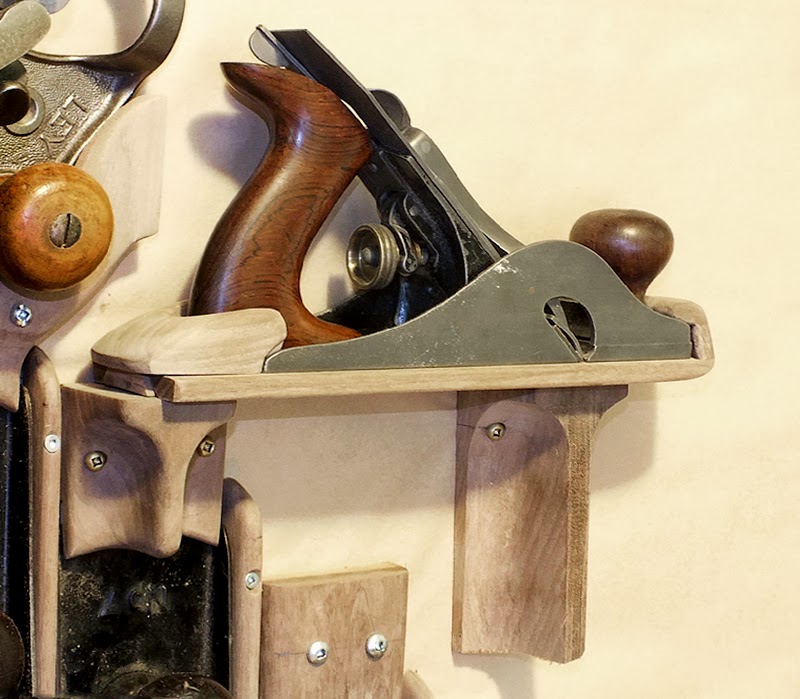
The mount for the accessories for the Stanley 72 plane is assembled and shaped and the 72's mount, which I posted about after it was assembled, has been shaped as well. Here is the end results...


The plane mount is 2¼" deep with a top surface that is ½" higher in front than it is in back so the plane leans into the cabinet. It has a connected back for mounting that is at right angles to the base so the plane has something solid to lean on. Both pieces were ripped to the angle.

Three other plane mounts are tied into this mount below it, one for the No.2 and the other two currently used for 2 identical block planes. The centre slot is for a No.1, if I ever decide that I want it. At a $1000-plus, I am happy that I don't want it right now, but I may change my mind about that in the future, so I kept my options open.

I glued a gusset to the underside of the base and the lower portion of the back that was 1" by 1" strip of walnut ripped at 45°. Using a 1" round plane, I turned it into a congé, which I think is the right term for this type of moulding.

I thought it might be a bit of a pain to place the plane in the mount, but it isn't. I just have to drop the toe of the plane into it and slide it forward until the frog hits home under its capture, which registers it so the heel just falls into place behind the heel-block when I drop it down. It is not as techie as I had originally perceived these mounts to be, but by the look of it, it works.

The two accessory mounts were also tied to two upper mounts for planes mounted below them; the No.4 and the No.3. These were made out of three pieces each, one 1" thick and two 3/8" thick. The render below shows how the assembly and shape was handled. Once the two mounts were assembled, they were glued together and the 1" round was used to create the congé.


You can see in the photo that the right mount is for the Beader attachment, while the left is for the Bullnose. I don't own the Bullnose yet, but I am looking. I will also mention that I have an extra "B-cast" standard toe that I'd like to sell, so if any of you are interested, please get in touch. I looked at the standard toe and realized that all Stanley did was modify the forward portion of the casting for it to make the bullnose, or at least I hope they did, otherwise this mount isn't going to work when I finally come up with one.

These attachments "hang" on the large wing nut that is used to connect them to the plane body. These wing nuts have a large collar cast in them, just above the threads, and it is that collar that rests in the slots cut into the mountings' faces. It works well, holds the piece securely, and results in the pieces being displayed in full. The shot below shows the mounts with the extra standard toe as a stand-in. I am counting on the bullnose not hanging down as far as this standard toe does.

I will revisit the Stanley No.10½ mount again, creating a new one that matches this design. Hopefully, I won't run into another "What the #$!@???" again, but I'm not counting on that either.

Peace,

Mitchell


Friday, 4 October 2013

Has It Ever Happened To You...

How many of you have encountered the "What the #$!@???"

This situation doesn't happen very often, I'm sure, but I don't think there is a woodworker out there who hasn't had to face it once or twice over the course of being involved with this hobby. Some, like me, face it more often then they would care to admit.

You head out to the shop, or wherever it is you do your woodworking, to put the last finishing touches on your latest project, or part thereof. If it is a difficult one, your chances of meeting up with it are far more likely than with the simple builds. The more hours you spent on it, getting to the point of being near completion, the higher the chances. You walk in and more than the project is waiting for you. You anxiously look at the result of your hours of toil and...wham!
"What the blankety-blank-blank was I thinking?" 
There is no other way to describe it; you come face to face with the fact that the job that you spent so long designing and so lovingly creating, actually looks like shit!

I ran into this with the mount for the Stanley No.10½, the one I had pondered about for the last year, the one I spent a few weeks on tweaking the design, the one I spent the better part of almost 7-days building and refining, and the one I posted pictures of for the world to see here on my blog.

The day after I posted those photos I thought I would take an hour or so to finish up shaping it and getting it to the point where I could finish sand it. I walked into my office, looked at it, and actually thought my wife had snuck in during the night and changed it on me. The proportions were out of whack, the slider hung out the end like a mis-placed shirt-tail, and the brackets were silly and incorrectly placed. I couldn't believe I could build such a thing, let alone design it.

My first thought was to modify it, but that wouldn't help the proportions, so I knew coming up with something different was the only way to go. Because this cabinet includes a small work area at the top of its base that will, hopefully, be used often, these tools have to endure a bit of shaking around and stay in the mount when they do. That was the reason for the sliding dovetail lock, but I started to think I may be over-building here. I tried a few experiments and found that it didn't take much of a lean backwards to keep the tool from falling forward. I then calculated that if I keep the tool from moving side to side, a ½" lean over a 2½" base was enough to hold it in place through anything short of a hurricane. I was surprised, given I built the cabinet itself with a ½" forward lean over its 6' height. I did this to counter the weight that the tools add to the back wall of it. With this new information, off I went to make some sawdust.

The mount I decided to make was for my Stanley 72, and this is what I came up with...
It has only been cut and assembled, and not shaped yet, other than the fillet across the bottom of the shelf to help support it. I'll keep at it and make the two additional pieces as well; one for the beading attachment and one for the bullnose. Once these are done, I'll post a bunch of photos and talk about it a bit more.

I just wanted to get this one image up to show those who thought, "What the #$!@ was he thinking?"

Peace,

Mitchell

Monday, 23 September 2013

The Old Man's Reaction...

I was thinking this morning about how my old man would have reacted to the current rebuilding of my tool cabinet. Here is how I think that conversation would have played out...
Old Man: What the hell do you think you're doing?
Son: Nothing. Why?
Old Man: Because it looks more like you are building furniture, that's why.
Son: Come on, pop. I'm just making a display for my tools that I can enjoy looking at and still be able to use them. 
Old Man: What the hell are you talking about? Tools are only made to be used, not looked at. What the hell do you think they are, artwork? 
Son: Well, pop, they may have been made to work with, but that doesn't mean their designs shouldn't be appreciated. Some of them are really quite beautiful in their own right; like little sculptures. 
Old Man: Awe, bullshit! Do you ever listen to yourself when you talk that artsy-fartsy stuff? If you have to do this kind of pamby-assed thing, just bang a few nails in the back of the cabinet and hang the bloody tools on them. Stop making such a big deal out of nothing, for Christ's sake. 
Son: The cabinet sits in my office, remember, not the basement. I don't want to look at something like that all the time. I want it to look good. 
Old Man: Well if you spent more time working and less time looking, you might actually accomplish something.
Son: I'm retired, pop, remember? 
Old Man: Your too young for that nonsense, but ok, you want to sissify a bunch of tools; I can live with that, but do you have to spend so God-damned much money to do it? Walnut costs a bloody fortune. 
Son: It isn't sissified, pop. I just see things differently than you, thats all. And as far as building it out of walnut, I chose it because I know it was your favourite wood. The whole thing is sort of a tribute to you, if you must know. 
Old Man: Tribute - Schmidute. If you want to build something for me out of an expensive wood like walnut, build me a damned coffee table!
And with that, folks, he would have turned on his heel and stormed away, leaving me standing there shaking my head in wonderment. As he stormed away, though, I know he would have been wearing a grin from ear to bloody ear, the grumpy, old codger.

Peace,

Mitchell

Friday, 20 September 2013

Standing Tall...Not Me - The Plane...

It took a bit longer than I expected, but the 10½ now has a mount, or at least one that is as far as I can take it for now.

Here is where the mount stands right now...


There is a cap missing at the left end of the base which has to be added to lock in the sliding dovetail of the heel mount and extend the base to its full length. I can't add that piece until the final glue-up because, for strength, it has to be glued to the finished bracket below it, rather than to the end grain of the base. The right bracket is also unfinished as it still has to be altered to accommodate whatever tool I decide to mount below it. Until that happens, I have to be able to disassemble the entire mount.

While I stated I wanted to keep the mounts for each tool as separate as possible, I just couldn't resist including the left bracket that holds up the 10½ with the upper mount for the No.7 mounted below. This resulted in remaking the No.7's upper mount, but I think it was worth the effort and wasted material, despite the maze appearance. I thought I left enough waste on all the upper mounts, but as it turns out, I didn't.

Yes, I know, if I had drawn up plans beforehand, this problem wouldn't exist, but realize that drawing up plans for a layout like this would probably take as long to do as it would to make the layout. Also, in a case like this; mounting a tool is one thing, but getting it in and out of that mount is quite another. Because of that, it is almost impossible to create a good set of working-plans in a 2-dimensional space and less than fool-proof creating them in 3-dimensions. You just can't take into account all the variables that come into play when it is time to place the tool into its mount and get it out again. I know, I tried as, remember, this is my fourth attempt at fitting-out this cabinet. For me, the challenge of a job like this is far more enjoyable working from a idea that is liquid in my head then it is working from a fixed commitment on paper. If I drew up a plan, each part of the design would have to be followed because all the other parts depend on it being made as it was drawn. If you change one part, you throw all the other pieces out of whack. You also can't think of everything. While I commit to creating the piece following the idea I have for it in my head, once I get into the actually making of it, designs and concepts come to mind that I never considered previously. If I was working from a plan, I would either have to ignore those new designs and concepts, or commit to them and risk throwing all the other pieces in the plan out the window. For me, not only is working with liquid ideas is more enjoyable, I think it makes the most sense in the long run.

Ok, so this mount is like the rest; made from solid walnut stock. Overall, it is, or will be when the toe cap goes on, 11" long and 2½" wide.

The sliding heel mount is made from two pieces; a 2" by 2¼" by 1" block for the top piece and a 1" wide by ³⁄₈" thick by 1½" long piece for its dovetailed slider. These two pieces are joined by glue and two small screws from the underside so replacing them will be possible if one or the other breaks down the line.

The toe mount was also made from two pieces; the top piece having its grain running with the base and the second piece, the spacer, glued under it with its grain running across the base. These three pieces were cut to size individually with the only fitting done to the spacer, shaping one edge so it fit tightly against the toe of the plane. Once all three were to size, they were glued together and then shaped as one.

The dovetail pathway was cut in the base using a fine Disston dovetail saw, then cleaned up with a chisel and smoothed with sandpaper. The dovetail slider was shaped using a plane then, like its pathway mate, had its edges smoothed with paper.

The two brackets that support the mount were made together from one piece of stock 2" by 2" by 8" long. I created a step-down in two of its corners on both sides of the stock using three sizes of Forstner bits. I then rough-shaped these and the stock between them using gouges and chisels, smoothing the results using blocks and sandpaper.

Once I had the different pieces shaped and set together in their final configuration, I then decided which edges and corners would be rounded over and by how much. I used a chisel to rough them in to define their radius, then smoothed them out with sandpaper.

Sandpaper is frowned upon by many, and while it is true that a good plane and scrapper will work rings around sandpaper on larger stock, with these small, fiddly, little pieces I didn't have much choice. Besides, I like working with sandpaper as it allows me more control when it comes to finer details. Maybe this comes from all the work I have done on car bodies over the years, I don't know, but it works for me.

Because discussions of sanding are not covered as much as other tools on the web, I have assembled a few rules for using it below. These rules are based on what I learned decades ago while working as an apprentice auto-body man. My love of cars got me into that apprenticeship, and while I'm thankful for it teaching me that I didn't want to grow up to be a body man, it also taught me what I did want to know, like how to shape material using different tools, including sandpaper.
  • When you start the sanding process, get comfortable, your going to be at it for a while. To sand properly, it takes much more patience than you think. With this job, I have gotten into the habit of hauling the stuff I need, including a drink and snack, out onto our front porch and settling down on one of its steps for the long-haul. The open air disperses the dust and the neighbourhood traffic offers me enough distractions to keep me interested in continuing on until the job at hand is done.
  • Whenever possible, use a block, no matter how uncomfortable using one turns out to be.
  • If you are working a flat surface, use a flat block. The longer the stock, the longer the block. This may mean buying your paper in rolls, rather than sheets, if you are working longer boards. There is a point, however, where even a dedicated sander like myself will turn to a long plane with a sharp blade and a scraper with a good hook over an array of sandpaper in assorted grits. There is no denying that, on longer boards, the former is much better and faster than the latter.
  • When working a rounded surface, make or find something hard that fits the contour you are working on to use as a block. As my wife never reads these posts, I can be honest here and tell you that her stainless steel container that she loves having on our kitchen counter to hold all her fancy cooking utensils has a radius that is an exact match to the curvature of the toe on a Stanley plane. I think you can imagine how I came to know this.
  • Use course grits to waste stock and rough-shape the larger areas of the piece. I never go rougher than 80-grit. The exception to this is when I'm working harder wood, which can force me into using 60-grit to help get the job done in a reasonable amount of time.
  • To get the initial shape true and flat, whether a contour or a flat, wrap an appropriate block with the sandpaper and work in a 45° angle to the grain, first in one direction, then at 90° to that first angle. Working in cross-grain directions will cut away the high spots and not allow the different types of veins in the wood to affect the block's travel. Once you have the area flat or evenly contoured, sand it again, still using the block, in the same direction as the grain to remove the scratches.
  • Change your approach to the piece every so often to "see" the surface. This sounds weird, but when you sand, the pressure you exert on the paper is stronger on the forward stroke than it is on the return. Changing the approach, or the direction you are working from, results in a change in the direction of the paper's cut, raising the grain in an opposing direction. When you look at the wood under properly angled light not long after you started working from the new direction, you can quickly see areas that are slightly different in colour. Usually, the darker areas are the high spots and the lighter areas are the low ones, giving you a guide to tell you how you are progressing.
  • To keep edges square, never allow more than a quarter of the block's length to pass beyond the end of the surface. If that requires shortening your strokes considerably, then so be it.
  • Change your grit according to the area you are shaping. The finer the detail - the finer the grit.
  • Once shaped and you begin to work a finished surface, always, always, always work the paper in the same direction as the grain, no matter what grit you are working with and no matter how uncomfortable or short your strokes have to be.
  • Don't leapfrog over grits to finish the piece quicker. It doesn't work. The pieces I have made so far are NOT ready for finishing with varnish. They are only shaped. When I am ready to finish them, I will return to the 80-grit wrapped blocks to ensure the larger surfaces are true, then go to 120, then 180 and finish with 220. I will then wipe each piece with a damp towel. One purpose for this is to raise the grain, which I take down with 220-grit. The other important reason to do this step is so you can "see" scratches and flaws. Any scratches and flaws that show on a damp piece will also show even worse on a varnished piece. 
  • To explain how a finished surface works; when light hits a surface with imperfections, it bounces off at different angles, which you see as a dull finish. When light bounces off a truer surface, the rays are reflected in a more uniformed direction and you see it as being shiny. Varnishes even out the surface and make it truer, causing the light to reflect uniformly. Special "flattening" additives are added, the amount dependant upon whether or not you want a flat, sheen, semi-gloss or high gloss finish. A flat varnish has a great deal of these additives while a gloss varnish hasn't any at all. They all produce a truer surface, but those with the flattening additives cause the light to bounce in a non-uniform manner, not only off the surface imperfections, but off the varnish's additives as well, masking the surface imperfections in the process. With gloss varnish, the truer surface reflects the light uniformly while the surface imperfections don't, making them stand out like a sore thumb.
  • If a piece is going to be stained and/or varnish, I wouldn't go finer than 220-grit. If a surface is any smoother than that, the adhesion ability of the varnish will be compromised. The Varnish needs a "tooth" to hold onto, seeping into their nooks and crevices. Make the surface to stick and the thick varnish won't have anything to seep into. Wax raw wood, however, is a different story. When waxing, the smoother the surface the better. If a piece I am working on is to be only waxed, I will continue on from the 220-grit with 280, then 320, doing the final sanding with 400-grit. It doesn't stop there, though, as I then apply multiple coats of wax using a progression of ever-finer steel wool, the steel wool taking over where the sandpaper left off. When working very hard woods, I'll follow the same process but instead of stopping the sanding at 400-grit, I'll do one more with 600-grit, then apply the wax as explained before. The steel wool isn't as effective on hard woods as it is on soft, so I find that extra grit helpful in ensuring a good finish.
As for the cabinet, here is an over-all shot of its slow progression.


I'll see you again in a few days to show you what I end up mounting beneath it.

Peace,

Mitchell