Monday, 23 September 2013

The Old Man's Reaction...

I was thinking this morning about how my old man would have reacted to the current rebuilding of my tool cabinet. Here is how I think that conversation would have played out...
Old Man: What the hell do you think you're doing?
Son: Nothing. Why?
Old Man: Because it looks more like you are building furniture, that's why.
Son: Come on, pop. I'm just making a display for my tools that I can enjoy looking at and still be able to use them. 
Old Man: What the hell are you talking about? Tools are only made to be used, not looked at. What the hell do you think they are, artwork? 
Son: Well, pop, they may have been made to work with, but that doesn't mean their designs shouldn't be appreciated. Some of them are really quite beautiful in their own right; like little sculptures. 
Old Man: Awe, bullshit! Do you ever listen to yourself when you talk that artsy-fartsy stuff? If you have to do this kind of pamby-assed thing, just bang a few nails in the back of the cabinet and hang the bloody tools on them. Stop making such a big deal out of nothing, for Christ's sake. 
Son: The cabinet sits in my office, remember, not the basement. I don't want to look at something like that all the time. I want it to look good. 
Old Man: Well if you spent more time working and less time looking, you might actually accomplish something.
Son: I'm retired, pop, remember? 
Old Man: Your too young for that nonsense, but ok, you want to sissify a bunch of tools; I can live with that, but do you have to spend so God-damned much money to do it? Walnut costs a bloody fortune. 
Son: It isn't sissified, pop. I just see things differently than you, thats all. And as far as building it out of walnut, I chose it because I know it was your favourite wood. The whole thing is sort of a tribute to you, if you must know. 
Old Man: Tribute - Schmidute. If you want to build something for me out of an expensive wood like walnut, build me a damned coffee table!
And with that, folks, he would have turned on his heel and stormed away, leaving me standing there shaking my head in wonderment. As he stormed away, though, I know he would have been wearing a grin from ear to bloody ear, the grumpy, old codger.

Peace,

Mitchell

Friday, 20 September 2013

Standing Tall...Not Me - The Plane...

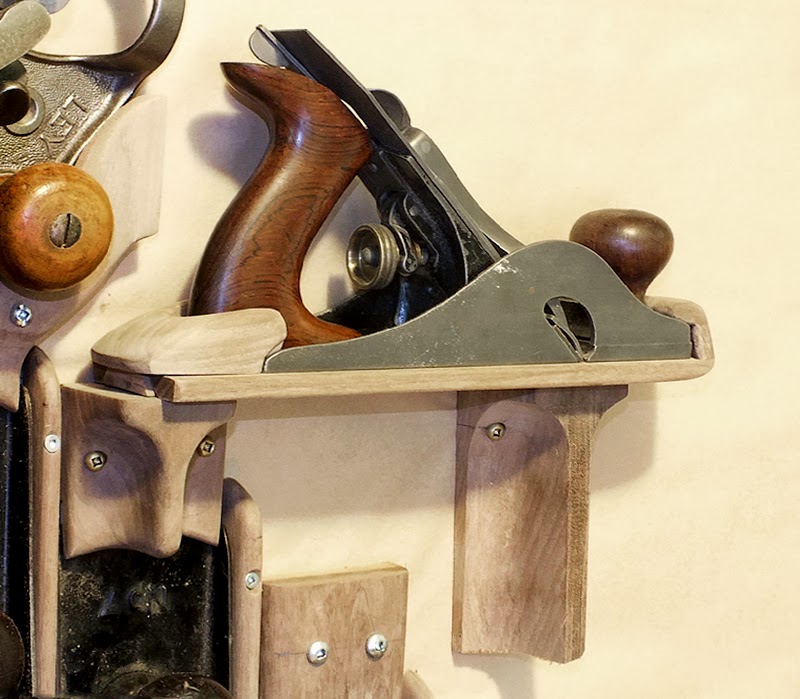
It took a bit longer than I expected, but the 10½ now has a mount, or at least one that is as far as I can take it for now.

Here is where the mount stands right now...


There is a cap missing at the left end of the base which has to be added to lock in the sliding dovetail of the heel mount and extend the base to its full length. I can't add that piece until the final glue-up because, for strength, it has to be glued to the finished bracket below it, rather than to the end grain of the base. The right bracket is also unfinished as it still has to be altered to accommodate whatever tool I decide to mount below it. Until that happens, I have to be able to disassemble the entire mount.

While I stated I wanted to keep the mounts for each tool as separate as possible, I just couldn't resist including the left bracket that holds up the 10½ with the upper mount for the No.7 mounted below. This resulted in remaking the No.7's upper mount, but I think it was worth the effort and wasted material, despite the maze appearance. I thought I left enough waste on all the upper mounts, but as it turns out, I didn't.

Yes, I know, if I had drawn up plans beforehand, this problem wouldn't exist, but realize that drawing up plans for a layout like this would probably take as long to do as it would to make the layout. Also, in a case like this; mounting a tool is one thing, but getting it in and out of that mount is quite another. Because of that, it is almost impossible to create a good set of working-plans in a 2-dimensional space and less than fool-proof creating them in 3-dimensions. You just can't take into account all the variables that come into play when it is time to place the tool into its mount and get it out again. I know, I tried as, remember, this is my fourth attempt at fitting-out this cabinet. For me, the challenge of a job like this is far more enjoyable working from a idea that is liquid in my head then it is working from a fixed commitment on paper. If I drew up a plan, each part of the design would have to be followed because all the other parts depend on it being made as it was drawn. If you change one part, you throw all the other pieces out of whack. You also can't think of everything. While I commit to creating the piece following the idea I have for it in my head, once I get into the actually making of it, designs and concepts come to mind that I never considered previously. If I was working from a plan, I would either have to ignore those new designs and concepts, or commit to them and risk throwing all the other pieces in the plan out the window. For me, not only is working with liquid ideas is more enjoyable, I think it makes the most sense in the long run.

Ok, so this mount is like the rest; made from solid walnut stock. Overall, it is, or will be when the toe cap goes on, 11" long and 2½" wide.

The sliding heel mount is made from two pieces; a 2" by 2¼" by 1" block for the top piece and a 1" wide by ³⁄₈" thick by 1½" long piece for its dovetailed slider. These two pieces are joined by glue and two small screws from the underside so replacing them will be possible if one or the other breaks down the line.

The toe mount was also made from two pieces; the top piece having its grain running with the base and the second piece, the spacer, glued under it with its grain running across the base. These three pieces were cut to size individually with the only fitting done to the spacer, shaping one edge so it fit tightly against the toe of the plane. Once all three were to size, they were glued together and then shaped as one.

The dovetail pathway was cut in the base using a fine Disston dovetail saw, then cleaned up with a chisel and smoothed with sandpaper. The dovetail slider was shaped using a plane then, like its pathway mate, had its edges smoothed with paper.

The two brackets that support the mount were made together from one piece of stock 2" by 2" by 8" long. I created a step-down in two of its corners on both sides of the stock using three sizes of Forstner bits. I then rough-shaped these and the stock between them using gouges and chisels, smoothing the results using blocks and sandpaper.

Once I had the different pieces shaped and set together in their final configuration, I then decided which edges and corners would be rounded over and by how much. I used a chisel to rough them in to define their radius, then smoothed them out with sandpaper.

Sandpaper is frowned upon by many, and while it is true that a good plane and scrapper will work rings around sandpaper on larger stock, with these small, fiddly, little pieces I didn't have much choice. Besides, I like working with sandpaper as it allows me more control when it comes to finer details. Maybe this comes from all the work I have done on car bodies over the years, I don't know, but it works for me.

Because discussions of sanding are not covered as much as other tools on the web, I have assembled a few rules for using it below. These rules are based on what I learned decades ago while working as an apprentice auto-body man. My love of cars got me into that apprenticeship, and while I'm thankful for it teaching me that I didn't want to grow up to be a body man, it also taught me what I did want to know, like how to shape material using different tools, including sandpaper.
  • When you start the sanding process, get comfortable, your going to be at it for a while. To sand properly, it takes much more patience than you think. With this job, I have gotten into the habit of hauling the stuff I need, including a drink and snack, out onto our front porch and settling down on one of its steps for the long-haul. The open air disperses the dust and the neighbourhood traffic offers me enough distractions to keep me interested in continuing on until the job at hand is done.
  • Whenever possible, use a block, no matter how uncomfortable using one turns out to be.
  • If you are working a flat surface, use a flat block. The longer the stock, the longer the block. This may mean buying your paper in rolls, rather than sheets, if you are working longer boards. There is a point, however, where even a dedicated sander like myself will turn to a long plane with a sharp blade and a scraper with a good hook over an array of sandpaper in assorted grits. There is no denying that, on longer boards, the former is much better and faster than the latter.
  • When working a rounded surface, make or find something hard that fits the contour you are working on to use as a block. As my wife never reads these posts, I can be honest here and tell you that her stainless steel container that she loves having on our kitchen counter to hold all her fancy cooking utensils has a radius that is an exact match to the curvature of the toe on a Stanley plane. I think you can imagine how I came to know this.
  • Use course grits to waste stock and rough-shape the larger areas of the piece. I never go rougher than 80-grit. The exception to this is when I'm working harder wood, which can force me into using 60-grit to help get the job done in a reasonable amount of time.
  • To get the initial shape true and flat, whether a contour or a flat, wrap an appropriate block with the sandpaper and work in a 45° angle to the grain, first in one direction, then at 90° to that first angle. Working in cross-grain directions will cut away the high spots and not allow the different types of veins in the wood to affect the block's travel. Once you have the area flat or evenly contoured, sand it again, still using the block, in the same direction as the grain to remove the scratches.
  • Change your approach to the piece every so often to "see" the surface. This sounds weird, but when you sand, the pressure you exert on the paper is stronger on the forward stroke than it is on the return. Changing the approach, or the direction you are working from, results in a change in the direction of the paper's cut, raising the grain in an opposing direction. When you look at the wood under properly angled light not long after you started working from the new direction, you can quickly see areas that are slightly different in colour. Usually, the darker areas are the high spots and the lighter areas are the low ones, giving you a guide to tell you how you are progressing.
  • To keep edges square, never allow more than a quarter of the block's length to pass beyond the end of the surface. If that requires shortening your strokes considerably, then so be it.
  • Change your grit according to the area you are shaping. The finer the detail - the finer the grit.
  • Once shaped and you begin to work a finished surface, always, always, always work the paper in the same direction as the grain, no matter what grit you are working with and no matter how uncomfortable or short your strokes have to be.
  • Don't leapfrog over grits to finish the piece quicker. It doesn't work. The pieces I have made so far are NOT ready for finishing with varnish. They are only shaped. When I am ready to finish them, I will return to the 80-grit wrapped blocks to ensure the larger surfaces are true, then go to 120, then 180 and finish with 220. I will then wipe each piece with a damp towel. One purpose for this is to raise the grain, which I take down with 220-grit. The other important reason to do this step is so you can "see" scratches and flaws. Any scratches and flaws that show on a damp piece will also show even worse on a varnished piece. 
  • To explain how a finished surface works; when light hits a surface with imperfections, it bounces off at different angles, which you see as a dull finish. When light bounces off a truer surface, the rays are reflected in a more uniformed direction and you see it as being shiny. Varnishes even out the surface and make it truer, causing the light to reflect uniformly. Special "flattening" additives are added, the amount dependant upon whether or not you want a flat, sheen, semi-gloss or high gloss finish. A flat varnish has a great deal of these additives while a gloss varnish hasn't any at all. They all produce a truer surface, but those with the flattening additives cause the light to bounce in a non-uniform manner, not only off the surface imperfections, but off the varnish's additives as well, masking the surface imperfections in the process. With gloss varnish, the truer surface reflects the light uniformly while the surface imperfections don't, making them stand out like a sore thumb.
  • If a piece is going to be stained and/or varnish, I wouldn't go finer than 220-grit. If a surface is any smoother than that, the adhesion ability of the varnish will be compromised. The Varnish needs a "tooth" to hold onto, seeping into their nooks and crevices. Make the surface to stick and the thick varnish won't have anything to seep into. Wax raw wood, however, is a different story. When waxing, the smoother the surface the better. If a piece I am working on is to be only waxed, I will continue on from the 220-grit with 280, then 320, doing the final sanding with 400-grit. It doesn't stop there, though, as I then apply multiple coats of wax using a progression of ever-finer steel wool, the steel wool taking over where the sandpaper left off. When working very hard woods, I'll follow the same process but instead of stopping the sanding at 400-grit, I'll do one more with 600-grit, then apply the wax as explained before. The steel wool isn't as effective on hard woods as it is on soft, so I find that extra grit helpful in ensuring a good finish.
As for the cabinet, here is an over-all shot of its slow progression.


I'll see you again in a few days to show you what I end up mounting beneath it.

Peace,

Mitchell

Friday, 13 September 2013

Tool Cabinet v4.0 Update...

So this is where I was at when I called it quits today...


It wasn't actually the most productive day I have had in a while. Throughout the afternoon I kept making one mistake after another. While checking the calendar to answer a question for my wife I realized that it was Friday the 13th. Not wanting to continue to tempt the fates, I packed it in, took a couple of pictures and called it a day.

All I got for about 4-hours of work was a mounted Veritas Low-Angle Jack Plane with uncentred mounts...damn, and this...


The mount for the Stanley 71 with all its accompaniments will give you an idea of where I'm headed with this. I'm trying to produce something that flows together, which is why the accessory display is moulded to the mounts and the bottom mount for the 71 is also the top mount for the No.8. While I'll do the moulding trick to all the tools that have accessories, I won't do the combined mounts that often. I think that if it is done once too often, it will start to resemble a crazy maze.

I kept the sides of the 71's mounts square as I don't have a clue yet which plane I'm going to mount beside it. I know the 271 has to fit in here somewhere, but I'm just not sure where yet. By keeping the ends square and keeping the horizontal-grained bottom layer shorter than the top, it will be an easy process to tie into them to continue on. If I don't want a continuation of the mounts, I can just reshape what's there to whatever I find pleasing.

And speaking of shapes, as you can see, there are no fancy edges or carving on any of these, even though 80% of the work on each has been done with chisels. I thought the hard look of the tools would be accentuated and would add more to the display if they were placed up against soft curves, so the only shaping I'm doing on the mounts is giving all their edges a soft round-over. So far, it isn't really working for me, but I think once the walnut has a few coats of satin varnish on it, darkening it, the shape contrast might pop a little more and the tonal contrast will be less, at least I hope so.

Next up is the No.10½. I have been looking forward to getting at this one for a week or so, ever since I came up with a design for a horizontal locking mount for it. It should be an interesting build and a hell of a buzz if it works.

I'll catch you up on how I make out with it in a few days.

For my Jewish readers on this, the start of Yom Kippur, I wish you an easy fast.

Peace,

Mitchell

Wednesday, 11 September 2013

Tool Cabinet v4.0


I have finally quit mucking about and jumped into "Tool Cabinet v4.0" with both feet. This is where I was at last week, with more planes already added and other mounts on the bench that are close to completion.


As you can see, I've stripped everything out of two of the three display areas and have started putting it all back together yet again. Having spent two years analyzing my last three attempts at this, not to mention having analyzed photos of God knows how many other woodworkers' tool cabinets, I have a fair idea of what I want now and an almost equally fair idea regarding how to get it.

My thing with tools is that I get a kick out of their design. Some I think are brilliant, and some not so much, but either way, I like to look at them just as much as I like using them. This, as it turns out, is the main criteria for what I am looking for when it comes to a tool storage cabinet that I can be happy with. I also had to figure out if getting what I wanted meant starting again from scratch, or simply modifying what I have to make it work.

To give you a better idea of where I am coming from, let me give you some of my thoughts regarding a  cabinet and a chest that are currently all the rage.

Christopher Schwarz, thankfully, has brought the old tool chest back to its rightful place. Each of the many that he has made over the past few years are ready, willing and able to haul his tools wherever his livelihood takes him, or just keeping them all together in one spot in his shop. I'm not knocking him for pursuing a chest over a cabinet as I am sure he chose what works best for him. The thing is, while this style of tool storage works well for him and many others, it would be a disaster for me. This is because I neither travel with my tools, nor have a workshop, but more importantly, I collected my tools not only to use, but also for the pure joy of having them around. Hiding them away in a chest, in or out of a shop, would wipe out half of the enjoyment I bought them for in the first place. I think a chest is a fine answer to a specific purpose, but neither the chest, nor its purpose are a good fit for me.

The next most popular style I think has to be emulating Henry O. Studley's wall-hung tool cabinet. Lets face it, that is one beautiful piece of workmanship, but after looking at all the photos and videos of it, plus reading everything there is out there describing it, I came to the conclusion that it too wasn't for me. I also realized that my biggest mistake with my previous three attempts at making my cabinet work was that I too tried to emulate ol' Henry's work. The hardest part of getting to this conclusion was getting past the bling. Once I accomplished that, I was able to take a good look at his cabinet for what it is, a storage container for his tools. The bottom line is, ol' Henry built this cabinet so he could store his tools under lock and key when he went home at night. He did it in a blaze of glory, but once I got my head around this fact, it was easy to understand why his style of cabinet didn't work for me. The reason I came to this conclusion is simple; I can see there are three layers of tools in his cabinet, but damned if I know what any of them are below the top layer, and therein lies the rub.

There are a number of others that I looked at, but these two stand out as the best examples of what I don't want. The best example of tool storage that I do want is the wall-mounted set-up done by Steve Branam, over on the Close Grain blog. His tools are laid out in the best organized plan I have ever seen. He has full sight of each tool and accessing them is simply a matter of snatching and grabbing whichever one he wants. While the style of his set-up is something I would like to emulate, the problem I have with it is that I don't want to use an entire wall to do it. 

After analyzing everything in sight I was finally able to put together a short set of simple guidelines that outlined what I wanted.
  • I need a cabinet to hold all my tools
  • I want to be able to see each tool in its entirety.
  • I want each tool displayed at its best
  • I want to be able to access each tool quickly and easily

This, at first, caused me some problems as I realize that while my existing cabinet is large enough to hold all the tools I own, they all can't be displayed. That, to me, was a real shame, but then I realized what I said in the third paragraph of this post; I think the design of some of my tools are brilliant and some, not so much. Deciding which tools to house in the open display and which to display in the drawers was the key to creating a cabinet that I can be happy with. I also realized that displaying the tools hidden away was as easy as leaving the drawers open, so even the problems I came up with weren't as serious as I once thought they were.

Once I got a grip on what I wanted, I had to decide whether or not to start from scratch, or give what I had another go. The cabinet I have is made from ¾" marine-grade mahogany plywood. Marine-grade plywood doesn't have any voids between its layers so there is no place for moisture to collect. Add mahogany's ability to resist rot and you end up with material that should, under normal conditions, last a lifetime and more. The design is based on Henry Studley's and Norm Abram's wall hanging cabinets, but with my own twist. The main cabinet is 36" wide with a 36" by 36" by 5½" deep open display area on top and a 30" high by 24" deep drawer cabinet underneath. The open display area has two hinged display areas as well, each being 36" high by 18" wide by 4" deep. The thing is mounted on four heavy-duty casters and is made to roll through a standard door. Because the dimensions of this cabinet are as large as I can go, I realized that I was in for another remake.

When I built the cabinet I had yet to make the switch from power tools to muscle tools, so the number of hand tools I owned was limited. The image below shows the cabinet in its original configuration.


Once I was infected by the vintage tool bug, I started vigorously adding to my collection, forcing the original layout to become obsolete as it just didn't allow enough room for the newer additions. I then rebuilt the inside of the display areas to hold what I had, but sadly, I didn't take any photos of it.

That second rebuild lasted about two years before I ran out of room. I then rebuilt it for the third time, the image below showing the results of that third build.


It wasn't long before I had gone beyond the third rebuild's capabilities and since then I have had tools stored hither and yon throughout my office, most of which I can't see at a glance. I also realized that another serious problem had arisen because of my tool storage problem. Because it became such a hassle, loaded with frustration, finding and rounding up the tools I required for a project, I simply stopped taking on projects. Because I couldn't look at the tools easily, nor was I using them, I started to consider selling them, and that is when I realized I had better get my act together.

So the key to all of this is figuring out which tools to store in the open display areas and which to put into the drawers. My first choice was simple; my planes. I then had to figure out the best way to display each, so again, I started with the easiest choice, the bench planes.

The beauty of bench planes is their simplicity in design, but where they really shine is when they are displayed together. Each is a smaller version of the larger, and when they are lined up to accentuate their differences, I think they are a joy to behold. The result of this is seen in the photo below. I have added the rest of the set since taking this photo, but I think what I have here gives you the basic idea.


The mounts shown in the photos are not completed yet, but they are close. Each is made up of  two ³⁄₈" pieces of walnut glued together with opposing grains for strength. As you all have probably seen this type of mount a thousand times before, I'll just add a line drawing of their dimensions so you know how they work. I will mention here that the bottom layer is planed to the thickness required, depending on the plane it is made to hold while the top layer remains its full ³⁄₈". The bottom mounts are sized to allow 2" of space between the bottom of the plane and the top of the drawer cabinet, allowing room to swing the planes into place. There are ³⁄₈" wide by 1" deep walnut strips running down both sides of each plane that are to act as registers, minimizing the effort needed to thread the planes back into their mounts while reducing the chance of damage to their neighbours during the process.


These are the simple mounts, but they will become more complex as I work through the group. I am currently working on the mounts for my Stanley No. 71. These mounts are a tad more complicated on their own, but made even more-so because the bottom mount for the 71 is also the top mount for the Stanley No. 8, which is mounted below it. That will be an important part of the design; having one plane mount flow into another, giving an organic feel to the layout.

All the mounts will be made from solid stock black walnut, a tip of the hat to my old man who loved this species of wood. Because the backs of the display areas are so full of holes from the previous configurations, I'll create the layout for each display area, then remove everything and re-skin the inside of each area completely with black walnut veneer. Before I started adding mounts I taped kraft paper to the back panel so I can draw an outline of each mount. I will use this as a guide to make it easier to put the mounts back in their proper positions once the veneer is in place.

So that is about it for now. I am trying to work a little bit each day on this so I should have more to show within the week.

Peace,

Mitchell

Saturday, 17 August 2013

A Fantasy Becomes A Reality...


I’ve mentioned my ongoing relationship with eBay within these posts a few times. When we started this liaison, she promised me she would scan all the new listings that get added to her Collectable Tools section and offer me any that display the word that might turn me on; “Mitchell”. My part in all of this was to promise her that I would check out all that she had to offer me, “doing the dirty” with any that tickled my fancy. The old girl and I were going hot and heavy for a few years, but sadly, over the past year or so, it seems she has lost her ability to excite me. Bless her little heart, she did her best to entice me every week or so, but her obvious willingness just didn’t seem to do anything for me any longer.

The problem I had with her over this past year or so is that she started to repeat herself. She just couldn’t seem to find anything new to add to her repertoire, but instead, kept offering me the same old Adams Handrail Molding Plane with a Mitchell of Sheffield blade, a Mitchell & Co. Circular Compass Plane and a Mitchell Newhouse Lumber Co. Carpenter’s Nail Apron that she had tried to entice me with many times before. Instead of finding new Mitchell enticements to turn me on, she kept sending me relistings of the ones she had offered me many times before. I was beginning to tire of her.

Then, out of the blue, she suddenly got frisky and offered me something I have been fantasizing about for years.

I have to admit that my tool purchases have faded to zero this past year or two, but it is not through lack of trying. This calamity is a result of not having come across anything I really wanted to add to my collection. I still check out the vintage tool sites, but admittedly, not with the ferocity I once had. The one exception, however, is my search for any tools made by H.E. Mitchell of Brighton, England. Given the strong possibility that he and I are related, collecting examples of his work has admittedly become an obsession. In an attempt to assemble as many of them as I can, I still search the all the tool auctions and sales sites almost daily. Mitchell produced all types of joining tools throughout his career, but only advertised himself as a “Saw Maker”. The thing is, I have never come across a saw made by him in all the years I have been searching out examples of his work. The closest I ever came was finding a five-year-old listing for one offered in a Brown’s Tool Auction, meaning the saw was long gone.

A few weeks ago, though, my little sweetheart, eBay, suddenly gave one up.

A fellow from Oregon named “she352” had a listing entitled, “Mitchell of Brighton (England) 14” tenon saw”. I couldn’t believe what I was seeing. The listing included an array of good photos and a description that made sense. I was so excited, I didn’t read his shipping limitations and didn’t notice until this morning that it stated, “May not ship to Canada”. The listing was only a day old and I don’t remember if anyone had submitted a bid for it by the time I got to it, but I didn’t care. I hit the “Buy It Now” button, more than willing to pay the $90 he was asking for it.

As luck would have it, she352 turned out to be an above-board seller. When I got back on the computer the following morning, he had invoiced me for the $90 purchase plus a very reasonable cost to ship it to Canada, without even a mention about the “May not ship to Canada” statement that I hadn’t seen. Two weeks later, the postman was knocking on my door with my well-packaged saw in hand.

And what a saw!


I don’t have a micrometer, so I couldn’t measure it, but the blade is relatively thick, as I think a tenon saw blade should be. It is 3” deep at the toe and 3¼” at the heel, so there is plenty of meat still left on it. The brass back is 7/8” high by 3/8” thick. To say this is a heavy saw is an understatement as it weighs in at whopping 2¾ pounds, considerable heft for a 14” saw. There is no stamping on the blade, but the count of the teeth tells me it is filed 12 tpi, without a tooth missing in the lot. The blade has a very slight bow; so slight I didn’t notice it until I sighted down the blade for the third time, this last time using a strong light behind it. The blade has a lot of discolouration, but no pitting whatsoever. I rub down all my blades with wax, using a fine steel wool. I don’t know how much of the staining will be removed when I get around to treating this blade, but other than adding a bit of a shine, I doubt it will make much of a difference to it.


The handle appears to me to be made of apple and I think it is a pretty one.


The blade projects into the Boss a full 2¼”, held to the handle with two flush-faced brass screws and one medallion screw with the usual “Warranted Superior” emblazoned on it. All three screws use brass split nuts set flush on the opposing side. There is a small chip at the end of the well-defined, tapering Lamb’s Tongue on the right side of the blade and judging by the colour and wear of the break, it was done decades ago.


For me, the beauty in this well-made saw is in the stamp. Goodman, in British Planemakers, states that Henry Edward Mitchell started making tools in 1855. My research, however, tells me that Henry didn’t open his first shop until ten years later, doing so in Eastbourne, Sussex in 1865. His maker’s mark for this business was “Mitchell, Eastbourne”. His first shop had a short life, though, and he was forced into bankruptcy in 1868. He jumped right back up on the horse again, though, this time at 15 North Road in Brighton, changing his maker’s mark to, “Mitchell, Brighton”. By the mid-1870’s he was in full production at 4 North Road, Brighton and he changed his maker’s mark so his products wouldn’t be confused with any of the other Mitchells making tools at the time. His saw stamp was “H.E. Mitchell, Brighton”, and the stamp for all his other tools was, “H.E. Mitchell, 4 North Road, Brighton”. In the late 1880’s or early 1890’s, he added a lion’s head above his name on the stamp he used to mark his planes. Based on this history, I calculate that this particular saw was made between 1869 and 1974.

I discovered that Mitchell was very successful financially. He grew up a soldier’s son in the slums of London in the first half of the 19th century and went on to retire at the young age of 58 in 1900, spending his retirement years “living by his own means” in a country villa with a servant or two to tend to his daily needs. The guy was a hustler, through and through, and reaped the rewards of his life’s work as a result. This is what makes collecting examples of his work so frustrating. I just can’t figure out why tools made by someone this successful are so few and far between, especially the mainstay tools of his career – his saws. It makes no sense to me, but now that I have one, I am no longer going worry about it.


This is the first vintage tool I knew I would never use when I purchased it. When I switched from horsepower to handpower, I committed never to buy a tool that I would never use, but this one is the exception. For me, this one is far too special to do anything with, other than to polish it up and make a special display place for it in the tool cabinet.

To others, this may be just another old saw made by an obscure maker, but to me, it is my “Pièce de résistance” – a special addition to my special collection of woodworking tools made about 143-years ago by a relative of mine. When it comes to tools, it just can’t get any better than that.

Peace,

Mitchell

Wednesday, 22 May 2013

The Village Carpenter is Retiring...


It would appear that The Village Carpenter is no longer posting. Kari has decided to hang up her keyboard and go off in other pursuits. While I will miss her, I respect and understand her decision to give it up. Constantly sharing yourself on a blog isn't the easiest thing to do, and in fact, it can be a royal pain in the ass sometimes.


In truth, Kari was the driving force that got me into the blogging business. She is so damned talented, she should be ashamed of herself. I probably learned more from her postings than I ever learned from all the other blogs combined.

What I loved about Kari's posts is her lack of pretension. If you did a search through all her postings I would bet the back forty that you would never find the word "perfect" used that related to herself or her work. You and I might of thought the results of her skills were perfect, and maybe at times even Kari thought so too, but she is classy enough to never even hint she felt that way. She did what she did to the best of her abilities and then put it out there for the world to see.

All the best to you, Kari, in your future endeavours. You will be missed.

Peace,

Mitchell

Thursday, 16 May 2013

This is for Anonymous...


In my post from yesterday, Anonymous asked me if I was talking about a specific tool dealer, or giving "just a representative composite of tool sellers".

The short answer…

Anonymous, I was talking about tool dealers in general with no one specific seller in mind.

The long answer…

When I started collecting tools I had a rough idea what to expect as this wasn't my first barbecue. I had collected things in the past so I had a pretty good idea how it was going to go. 

At first, you fill up your shelves with all the little odds and sods that, in the vintage tool market, cost less than $100.00. That gets your feet wet and you learn how the market works. It also allows you to sort out the vendors, figuring out who you want to deal with, and more importantly, who you don’t.

Eventually, there aren't anymore of the cheaper bits that you want, so you start to move up the food chain, and there is lots of tools in the $100 to $400 range to keep you busy. Eventually, though, your shelf gets full of all you want from that category, so you move up to the next category, the $400 to $800 group. From my experience, there is a pretty limited selection in this category, especially when your sticking close to Stanley stuff, so it doesn’t take long before you are ready to move into the big category, the over $800 category.

My collection, other than the odd bits and pieces, has now put me in this last category. Here, you have to be ready to pay the big bucks for what you want, like a No.1 or a No.9. This is when your obsession with tools starts to cost you serious money, and when I get to the point of spending serious money, I want to be comfortable with not only what I am buying, but whom I am buying it from.

I blame my old man for this attitude. When I was a kid, my parents owned a corner variety store and I worked in it. There was a royal a-hole who walked into the store every single afternoon and bought a quart of milk and two packages of cigarettes. He did this seven days a week. I didn’t like this guy at all, and one afternoon after he left, my old man came up to me and told me that he never wanted to see me treat a customer that way ever again. I’m not sure what I did, but whatever it was, the old man didn’t like it. I thought my dad was kidding and answered that he knew the customer was a dickhead. His reply to me was, “Ya, he is a dickhead, but he is a dickhead that is helping to pay for the meal you are going to eat tonight. Treat him with appreciation or find yourself another job!”

When I lay out $1100 to $1400 for a Stanley No.9, I want to feel that parting with my hard-earned cash is appreciated, otherwise I’m not even going to bother looking for one.

To give another example of what I am talking about, all the grocery store chains here have automatic checkouts and I use them religiously. The reason for this is because the machine and the live tellers talk to me exactly the same and if I’m going to get automated responses, then it bloody well better be coming from a machine and not a live person whose wages I am helping to pay.

Actually, if I had my druthers, I wouldn’t shop at a place that held this attitude at all, but here we are talking about an entirely different situation. You see, I need to eat. I can’t survive without subsidence, so I live through the negative experience of shopping in a grocery store by doing my own scanning and bagging simply because it is the lesser of the two evils. When it comes to buying that No.9, however, I do have a choice. It is the furthest thing from a necessity of life that I can imagine. In other words, I can’t live without food, but I can live long and hard without a Stanley No.9.

There is one tool dealer that I mainly dealt with and if I go back to buying tools again, he will be who I will buy from again. My reason for saying this is simply because he never screwed me once on any of the tools I bought from him over the years, and I bought a lot of tools from him. That said, he was also one of the biggest offenders for not giving any information with his listings, but the few times I have visited his site lately, I see he has improved on that considerably. The thing is, I zeroed in on him and worked at trying to build a customer/dealer relationship with him, putting my money where my mouth is by spending between $3k and $5k over the years to do it. When I hit the top spending category, though, I had a niggling feeling that I was the only one working for that relationship. I appreciated him, but I’m not so sure he appreciated me. It is a free world out there and he has a right to run his business anyway he deems fit, but I am talking discretionary spending here, with the emphasis on discretionary. I may be the dickhead my old man was talking about, but I too was that dickhead who was helping to pay for that guy’s supper that night, and I didn’t feel like he appreciated it.

If I do get back into collecting and start looking for those few seriously priced pieces I would like to have, I won’t be looking to get kissed for my purchase, but I also won’t be willing to deal with a machine and do my own scanning and bagging either.

Peace,

Mitchell

Wednesday, 15 May 2013

Sucking the Joy out of Everything...


I must be getting old and grumpy in my old age, but woodworking and vintage tool sites no longer hold the charm they once did. In fact, I’m getting downright turned off by them.

I have known why I’m not that thrilled with them for quite some time, but I’ve been rather embarrassed to mention it as I’m positive I’m the only one that feels this way. I’m putting it out here now to test the theory.

To those that write woodworking columns…
Guys, I’m in this hobby for the fun of it and your anal retentive attitudes towards it has quickly taken the fun out of it. If I wanted to produce perfect dovetails, or any other joint or cut for that matter, I’d be going to school to learn the craft, rather than looking for down and dirty tips so I can get to the job at hand – which is having fun.

To those that sell vintage woodworking tools…
Guys, I’m in this hobby for the kicks and your take-it-or-leave-it attitudes towards my purchases have caused me to stop buying. I’m not looking for a one-of-a-kind, $5k ultimate brace. I’m looking for usable tools and, as with any purchase of any antique, I’d like a little history about my purchase. I’m not a tool historian and I absolutely have no desire to be one.
I could go on about this, but I'll put it out there to see what you guys think, if anything other than I'm nuts.

Peace,

Mitchell 

Sunday, 7 April 2013

Great Show - Lousy Economy...

The Tools of the Trade Show and Sale was held today in Pickering, a small community just north-east of Toronto. Many of the usual dealers to this twice-yearly event were on hand, with a couple that I hadn't seen before. I arrived fifteen minutes after the doors opened and was shocked at the number of people walking the booths looking for tools. It was probably one of the best turnouts that I have seen. There were so many people swarming the booths that I gave up trying to take photos of the wares.

Standing at the loo just before leaving, two dealers came in and bellied-up on either side of me and proceeded to discuss their poor sales for the morning. Just to remind them that I was standing between them in a rather vulnerable position, I commented that there didn't seem to be many in the crowd that were carrying packages. One of them replied that the reason for this, it seems, is that "they have everything already". As it turns out, the hall was chock-full of people, but the vast majority of them weren't buyers.

I can't say that I can blame the dealers for this situation. I checked out the pricing of every booth and each one had prices that reflected the economic reality of the day. In most cases, it was depressing to see what they were selling things for. An example of this was a Stanley No.10½ that I saw in Doug Orr's booth. It was right in that sweet spot for me; almost too good to be a user, but not quite good enough to be a collector. He was asking $110 for it, far below what I feel is a fair price, which would be $185. Not to prove the loo-dealer right, but I already have a really good 10½, so there was no reason for me to bite.

Another dealer had a Casey round plane, probably one of the widest I had ever seen. While records state that hollows and rounds run up to 1½-inches wide, I swear this one was at least 2-inches. It was so wide, at first I thought it was a gutter plane, but it was toteless. As I had flashlight in hand, checking out every makers stamp on every wood moulding plane in the place looking for H. E. Mitchell planes and saws, I saw that the maker's stamp on this one was, "Casey & Company", the precursor to "Casey, Kitchel & Company", "Casey, Clark & Company" and, of course, "Auburn Tool Company". In my opinion, this was a relatively rare moulding plane for which the dealer wanted a piddly 40-bucks.

So things were very close to a "perfect storm" category. The dealers had the right stuff. The prices they were asking as a starting point were fair. The buyers were out in full-force. The only thing missing to make the sale a success was bank managers - they just weren't onside this time.


The fall show will be held on November 17th this year. If you want more information about it, you can find it at http://www.ontarioantiquetools.com.

Hopefully those bank managers will come around by November and it will turn into a winner for the dealers and buyers alike. It wouldn't hurt if one or two of the dealers found a few H. E. Mitchell tools for me, either.

Peace,

Mitchell

Wednesday, 3 April 2013

I Knew There Was One Out There...

In a past post I asked if anyone had a vintage tool made by H. E. Mitchell. I mentioned that I would be either willing to buy it, but if it wasn't for sale, I would be grateful for a photograph of it. Someone was kind enough to follow through with that request.

I woke up a few weeks ago to find the following two images in my InBox...


The sender didn't include his or her name, nor was there any text at all accompanying the images. Just the photographs.

After a quick look I knew this saw was made by ol' Henry, so I quickly replied with a "thank you" and asked if it was for sale. I didn't receive a response, which was disappointing, but at least I now have an image of an elusive saw made by H. E. Mitchell.

This is huge for me - really huge.

In all the years I have been searching for H. E. Mitchell tools, I have never seen a saw of his, even though he stated in all his advertising that he was just a "saw maker". I saw an outdated listing for one that sold in an auction back in 2005, but it didn't include a picture of it. All this time I had no evidence that the man ever made one. Then these showed up. Wow.

The maker's stamp on the saw dates it from 1865 or 1866. I say this for two reasons. First, it has the "Eastbourne" address and ol' Henry only worked out of Eastbourne from 1865 until he went bankrupt in February of 1868. He then moved to North Road in Brighton and started again. The other reason for dating it from these two years is that the stamp only says, "Mitchell". Henry realized that his stamp could be confused with other tool makers named Mitchell so in the later half of 1866, he added the "H. E." to it.

Whoever sent me these photos, I thank you very much. You really made my day - week - month. I may not have the actual saw, but at least I have photos of one to show that the man actually made them.

Thank you.

Peace,

Mitchell

Sunday, 17 March 2013

My Bucket List Sprung a Leak...


While I was sitting around recuperating and watching every B-movie Netflix has to offer my mind kept running through my “bucket list”. What ever happened to the “ToDo List”? Who the hell came up with the stupid term, “bucket list”? Anyway, the more time I spent thinking about it the more I came to realize that the damn thing had sprung a leak. When it first came to mind it held an ungodly number of items. By the time I got off my butt and got to work on striking the items off of it, there was only one left on it to tackle as I realized that all the rest were fluff and bullshit.

Now most of you that read this will think that when my mortality kicked me in the head a couple of months ago, it shook a few screws loose and suddenly I am now starting to prepare for death. That assumption would be the opposite side of the truth. I never had a near death experience, or anything that even came close to one. Hell, when they were wheeling me down to the operating room all I was thinking about was getting out of that place so I could see my dog. I should explain that my wife was with me the entire time I was in the hospital but the dog wasn’t. The bases for this newfound purpose in life is on other thoughts, as I have no plans on dying anytime soon.

Here’s the deal. What struck me one day like a ton of bricks was that fact that out of everything my parents left behind - the bit of cash, the bit of real estate, the basement full of knick-knacks - the only thing that matters to me then and now is my father’s old tools. The fact that I paid him cash for them while he was still alive doesn’t hinder their meaning to me one iota. They were a part of him and that part sits in front of me day in and day out, 24-years after his death and I expect them to mean the same to me 24-years from now.

It was his little bit of his legacy that caused me to spend the last however many years adding to them, expanding the scope and depth of his collection. I have the 5 planes he made a living with and have added many more to expand the set. I have replaced tools of his that I destroyed when I was a kid and added others that I know he would have liked to have. What all of this means is that my legacy has become one of adding to his. This is what I want to leave to my son when it is time for me to move on. I don’t want him to feel obligated to keep the legacy going; he can dump it, sell it or put it in his basement and forget it. What I hope he does get from it, though, is that we are all part of who came before us. Whether we go off in an entirely different direction or stay constant to generations past, we start, because of nature and nurture, with the person who came before us as our base. As difficult as my old man was, I am proud of the fact that I am based on who he was and it is that concept that I hope to pass on to my son when he takes possession of these old tools.

With this in mind, I had a look at how I was storing all those tools and realized that I was coming up a tad short. Ok. In truth, I realized I was coming up a few miles short. I had to face it – my tool cabinet sucked.

In my defense, dealing with life has certainly got in the way of reaching my goal of building the kick-ass combo tool-cabinet/work-bench that I wanted to build. I also realized, though, that part of this downfall could be placed squarely on the fact that I love the look of tools and putting them away in a cabinet will put them out of sight. If I built the tool-cabinet/work-bench that I had in mind I wouldn’t have them spread all over my office shelves like they are, and as a result, I wouldn’t be able to look at them every day like I do now.

The only way to deal with all this is to rethink my original concept of a tool cabinet. Instead of making usability the priority, I have to rework the design to place the display of the tools at the forefront. This isn’t going to be easy, but for my own satisfaction, it has to be done. The result of going at this tool cabinet again not only achieves what I want to pass on to my son in the end but it will also allow me a fantastic sight day in and day out until the times comes around. Ok, it is a little selfish, but what the hell.

Originally, my tool cabinet started out looking like this…


The problem I had is that I kept buying more tools. Over time, I went from less than a 100 or so to way over 300 and the cabinet wasn’t originally built to store that many. I dumped the power tools in the bottom and added a third drawer in the base, which made the doors on it a pain, so they came off. I then started to reconfigure it, doing a complete overhaul three times and not scoring a winner with any of them. I was trying to make it another Studley chest but without his abilities, so naturally I was doomed from the start.

As a result of the added tools, the cabinet ended up looking like this...


The cabinet is made from mahogany marine plywood and while it needs some changes to the outside design, I do like it. It would be a waste to throw it away so I am going to have to modify it. That means increasing the depth of the centre section from 4 ¼” to a full 9” and increasing the depth of the two wings as well. I’m not going to draw up any plans for it, as I don’t enjoy working from them. I find working from plans constricting and I get a much larger buzz working from my head, changing things as I develop new ideas.

I’m starting with the centre section and the first order of business is to strip out everything I don’t like about it and start from scratch.

Here is where it sits today…


Peace,

Mitchell

Friday, 1 March 2013

Pssst...Wanna Buy a Dirty Tool...

It is getting on to spring and with the warmer weather comes the Tools of the Trade Show.

I have always truly enjoyed this show and have dealt with some of the best in the vintage tool trade there every year. I expect this year will be no different.

The show is held at the Pickering Recreational Centre in Pickering, Ontario, a town located just north-east of Toronto. You can get to it along Highway 401, and if you go, you won't be disappointed. Get there early, though, as the boys line up before the 10:00 am opening time so they can get dibs on the best stuff.

It would be nice to see representatives from the likes of Jim Bode Tools fame and The Best Things, but I'm not going to hold my breath. Sadly, a lot of our American cousins that are in this business like to sell to us Canadians, but damned if they want to meet us face to face. Thankfully, Martin Donnelly of Martin J. Donnelly Antique Tools fame, never misses making the trek up here to meet and greet many of his existing customers, as well as using it to schmooze some new ones.


If you need more information or you are a dealer, the shows website is here.

Mark Sunday, April 7, 2013 on your calendar, save a few shekels for the date and get your tuches up here. It is well worth the trip.

Peace,

Mitchell

Tuesday, 26 February 2013

Another Addition to the Collection...

I haven't been shy about telling the world I collect one particular 19th century toolmaker, one named H. E. Mitchell. I have researched his ancestry as well as mine, and while I haven't been able to literally put one of his in bed with one of mine, the fact that they two families trace back to the same town in Ireland leads me to believe we are related. There is also a number of other anecdotal bits of evidence to support this as well. Related or not, though, it is way cool to view a bunch of tools made 130 to 160 years ago that all display the same last name as mine.

Just this week I was able to add another counter-stamped coin to my Mitchell collection, this one advertising Henry Edward Mitchell's Edge Tool Grinding Mills, circa 1885. This one is similar to the previous one I purchased, a 10 centimes French coin, but this one struck in 1853. You can read about the previous counter-stamped coin that I purchased and what they are all about here.

(Image copyrighted by Simmons Gallery)
I bought this counter-stamped coin from Simmons Gallery
through their online auction. This is one of the most
professional companies I have dealt with to date.
While I am itching to get back into blogging, I'm not quite ready yet to start my next project so I decided to elaborate more on ol' Henry today. 

H. E. Mitchell planes were introduced to me by Jim Bode at Jim Bode Tools when he sold me an almost complete set of beading planes made by Henry. The name intrigued me so I started doing a little research and through that, contacted Gary, a very cool and knowledgeable guy who operates Toolemera. Gary didn't have any information on ol' Henry, so he gave me some advice as to where I could find some - he sent me to ancestry.com. Now I'm not sure what I did to Gary that would result in him treating me so badly, but I must have done something. While it is true that I found out more about ol' Henry than even his mother knew, the fact is, Gary fed me to the lion, the one known as genealogy.

Now I'm not sure if you are aware of ancestry, but I am sure you have viewed their many commercials and other promotions. Don't believe them. While it is true that it is quite easy to come up with 1874 census information on Henry Mitchell, what they don't mention is that there were probably 1200 other Henry Mitchells kicking around jolly old England in 1871, half of them related to each other. You have to be a real sleuth to figure out which one is which. It is mind boggling how families recycled given names through the generations back then. What is even more shocking is that, given the sad reality of the high child mortality rates back then, families had a habit of constantly reusing a deceased child's name. I have one ancestor who gave the name William to four consecutive sons. Sad. Maybe I'm blaming Gary for something he wasn't aware of. Maybe he doesn't know that when someone falls into the genealogy abyss, they really get caught up in it, similar to the way a junkie gets caught up with heroine. Maybe Gary just didn't know...or did he?

Anyway, here is what I discovered about ol' Henry...

H. E. Mitchell, Saw maker

Born:
December 5th, 1839
Regent Street, Chelsea, Middlesex, England
Source Citation: London Metropolitan Archives, Saint Luke, Chelsea, Register of baptisms, P74/LUK, Item 173


Parents:
Stephen Mitchell, full-time soldier and part time saw-sharpener
Charlotte (madden name unknown)


Baptized:
December 29th, 1839
Event took place at Chelsea St. Luke, Middlesex, England


1841 Census:
Living at 32 Blenhym Street, Kensington, Middlesex, England
Source Citation: Class: HO107; Piece 688; Book: 6; Civil Parish: Chelsea; County: Middlesex; Enumeration District: 12; Folio: 38; Page: 23; Line: 3; GSU roll: 438804

1851 Census:
Living at 9 Holland Street, Southmark, Surrey, England
Source Citation: Class: HO107; Piece: 1557; Folio: 221; Page: 40; GSU roll: 174790

Moved to Brighton:
Stephen was discharged from the army and moved his family to Brighton, England in 1851, approximately. At that time, Henry was 12 years of age.

1861 Census:
Living at 17 Kensington Street, Brighton, England
Father listed as a “Saw Sharpener”
Henry listed as a “Saw Maker”, unmarried and 21 years of age
Two brothers listed; George F. 9 yrs, Charles 6 yrs, both listed as born in Brighton
Source Citation: Class: RG9; Piece: 597; Folio: 165; Page: 17; GSU roll: 542668

1865 First Toolmakers Business:
It is believed that Henry started his first business in 1865, a saw making and tool dealership located in Eastbourne, Sussex
Henry was 26 years of age
Note that "British Planemakers from 1700" by W. L. Goodman, lists Henry E. Mitchell as starting his plane making business in 1855. This would have made Henry 16 years of age when he hung up his shingle, a tad too young even by 19th century British standards. I could find no evidence to support this claim as this, the bankruptcy, is the first true entry regarding his own business.

1868 London Gazette - Bankruptcy:
Filed for bankruptcy on February 20th, 1868
Operating as a Saw Maker and Tool Dealer in Eastbourne, Sussex
Residential address given is No.12 High Street, Brighton, Sussex
Granted an Order of Discharge on March 5th, 1868


1871 Census:
Living at 15 North Road, Brighton, England
Married to Mary Morton Hyland
5 children; Henry 10 yrs, Elizabeth 4 yrs, Mary 2 yrs, Percy F. 1 yr and Frederick W. 2 months
Also has servant, Edith Tanner 17 yrs.
Source Citation: Class: RG10; Piece: 1083; Folio: 46; Page: 2; GSU roll: 827499

1874 Postal Directory Listing:

Listings for Henry Mitchell’s business first appear in 1874
He is listed as being located at 4 North Road, Brighton


1874 Trades Directory Listing:
He also listed his business in the Trades Directory in 1874

1878 Trades Directory Listing:

Henry E. Mitchell is listed in the 1878 Post Office Directory


1881 Census:

Living and operating “H. E. Mitchell, Tool Maker” at 4 North Street, Brighton
His son Henry, EST. age 20, is not listed in this census, nor is Frederick W., EST. age, 10 yrs
(It was later confirmed that Henry Jr. passed away in 1877) 
Elizabeth, Mary and Percy are present, as well as Albert - 9 yrs, Edgar - 6 yrs and Violet - 3 months
Source Citation: Class: RG11; Piece: 1089; Folio: 70; Page: 1; GSU roll: 1341256

1882 Trades Directory Listing:

Henry E. Mitchell, Saw Maker is listed in the 1882 Kelly’s Directory


1891 Census:
Moved to Keymer, Sussex, England
Living at “Hatherley Villa” on Bella Vista Road
Daughter Elizabeth has married, last name now Hilton, but no husband listed at this residence but has a son, James 8 months
Violet still living with parents
Additional children; Daisy 10 yrs, Lily 5 yrs, Henry E. 3 yrs (supporting Henry C. passed) and Rose 2 months
Source Citation: Class: RG12; Piece: 793; Folio 68; Page 11; GSU roll: 6095903

Observation:
Keymer was a village north of Brighton. It was close enough for Henry to commute back and forth between his home and his business, but not without some difficulty back before the turn of the century.

1899 Trades Directory Listing:
In the Kelly’s Directory of 1899, Henry Edward Mitchell is listed twice
One listing states:
Mitchell, Henry Edward, Saw Maker and Green Grocer, 57 Coleridge Street, Hove


Change in Business Name:
In the Trades Directory of 1899, H. E. Mitchell, Saw Maker has been changed to Henry Edward Mitchell & Co. Ltd., Furnishing Ironmongers; Office & Stores, 4 North Road, Brighton


Observations:
While I have no evidence of this, I believe Henry realized that the steel plane industry was only going to take away more of his sales so he decided it was time to make a change. Two very rare examples of Henry’s ultimate baces showed a high level of metal work and I believe this craft was the specialty of Henry’s oldest living son, Frederick William. Based on those two assumptions, it is not surprising that the young Frederick took over the business on North Road in approximately 1898, incorporated it and started producing Iron fixtures for stores and offices. Given Henry’s age at the time, I don’t think he was ready to retire so he opened his combined green grocer and tool store where he continued sharpening saws, making planes and selling carrots and potatoes until he final called in quits in the latter part of 1900.

1901 Census:
Henry Edward 58 yrs, Retired Ironmonger
Living at “Hatherley Villa” on Bella Vista Road
Lily 17 yrs, Henry E. 15 yrs, Rose J. 10 yrs
Servant, Alise Spilargki 24 yrs
Lodger, Jeffery M. May 60 yrs, Living on own means
Source Citation: Class: RG13; Piece: 910; Folio: 75; Page: 16

Observation:
This is the first time Henry has used "Ironmonger" for his profession, although it is in keeping with the new direction of his business. All of the planes that I have in my collection have "Sheffield" blades in them, telling me Henry wasn't in the iron works business until his son took it over.

Death:
3rd Quarter 1914, Keymer, Sussex, England

Markers' Marks:
H. E. Mitchell’s makers' marks start with one that simply displays, “H. E. Mitchell, Eastbourne”. When he started his second business, his new mark was "H.E. Mitchell, Brighton". Around 1875 he started to consistently display his mark as “H. E. Mitchell, 4 North Road, Brighton”. In the early 1890s he added the lion crest to the text.


Observations:
Judging by the listings in the census throughout Henry’s life, his early bankruptcy aside, he was a reasonably successful businessman. His success is proven by his ability to retire at the early age of 58, living out his remaining years as a country “gentleman” in his servant run “villa”, located in a small town north of Brighton.

His business was always listed as “Saw Maker”, but he made a number of  “Joining Tools” for the carpentry and cabinetmaker trades. He was a dedicated promoter, never missing a chance to advance his business, as shown by his listings in the different directories and his use of counter-stamped coins, the equivalent of today’s coupons.

While his tools are very rare and difficult to locate today, I have recently found examples in England, the United States, Canada and Australia. While their numbers are very limited compared to other 19th century toolmakers’ examples, they do not command a premium in price.

Examples of Henry E. Mitchell’s Tools:
Here is a photo of my Mitchell collection as it stood in December 2010. Thankfully, I have been able to add a few more examples of his work since then.


Offer to Purchase:
If you have any examples of H. E. Mitchell tools in your cabinet, let me know what it would take to get you to part with them. If you have a saw or brace of his that you don't want to part with, I'd be forever grateful if you could send me a photo of them. My email address is mitchell@liquiddesigns.ca

While reaching out to ol' Henry's direct decedents I discovered that the vast majority of them didn't know Henry was a toolmaker. Not one of them held an example of his work, nor did they know anyone who did. My gut tells me we are related, so I am not collecting this man's work to use or as an investment. I am collecting them so future Mitchell's will know what their ancestors were all about.

Peace,

Mitchell